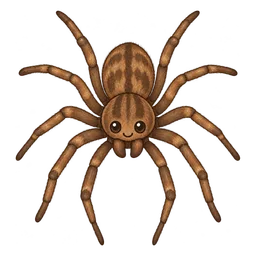
Spiders
Araneae (common U.S. household spiders) · Spiders & Centipedes
Most spiders found in U.S. homes are harmless. They eat insects and usually wander in from outdoors. Spiders do not hunt people, and many have fangs too small to pierce adult skin, so bites are uncommon and usually happen when a spider is pressed against skin in clothing or bedding. Many sores blamed on 'spider bites' turn out to have other causes, such as bacterial infections or other insects.
Look for: Eight legs, two body sections (a front part bearing the legs and a rounded abdomen), and no wings or antennae. Insects have six legs and three body sections.
Quick facts
| Legs | 8 |
|---|---|
| Usual colors | brown, tan |
| Where in the home | Living Room, Bedroom, Bathroom, Garden |
| Active | All year |
| Peak | Sep, Oct, Nov |
| U.S. range | Found throughout the U.S. The species that can seriously hurt people are mainly widow spiders (nationwide, most common in the South and West) and the brown recluse (south-central and Midwestern states). |
| Bites or stings people | Rarely |
Seasons are typical across much of the U.S. and vary by region.
Peak season Active Typical across much of the U.S.; varies by region.
Often confused with
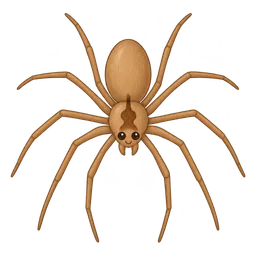 Brown RecluseLoxosceles reclusaUniformly tan to brown legs and abdomen with no stripes, bands or spines. A dark violin-shaped mark on the front body section, with the violin's neck pointing back. Six eyes in three pairs, which you need a hand lens to see.
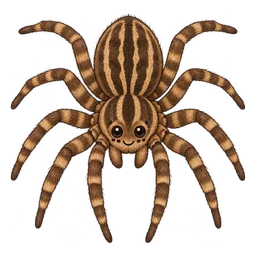 Wolf SpidersLycosidae (e.g. Hogna carolinensis, Tigrosa aspersa)A large, hairy brown-to-gray spider that runs along floors. Its legs often have lighter bands, and its eyes shine green in a flashlight beam at night. Females may carry spiderlings on their backs.
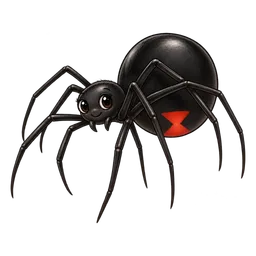 Black Widow SpidersLatrodectus spp. (L. mactans, L. variolus, L. hesperus)Adult female: a shiny jet-black spider with a large, round abdomen and a red-to-orange hourglass mark on the underside. Young spiders and males are smaller and tan or gray with light stripes.
Sources
- ipm.ucanr.edu
- citybugs.tamu.edu
- hgic.clemson.edu
- extension.illinois.edu
- hgic.clemson.edu
- cdc.gov
- content.ces.ncsu.edu
- entomology.ca.uky.edu
Not sure this is your bug? Try the Bug Identifier or ask your local Cooperative Extension office.