What Does a Brown Recluse Look Like?
Quick Answer
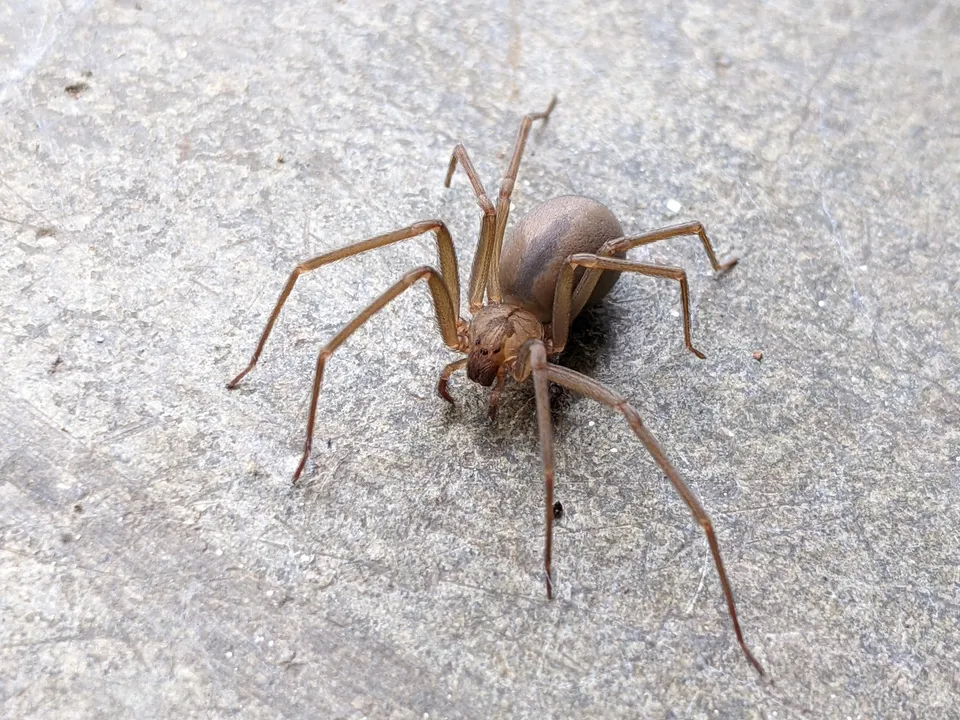
A brown recluse is a plain tan to dark brown spider that, with its legs spread, is about the size of a U.S. quarter. Its long, thin legs and its abdomen are one even color with no stripes, bands or spines. Most adults have a dark violin-shaped mark behind the eyes, but the surest sign is the eyes themselves: 6 eyes in 3 pairs, where most spiders have 8.
On this page
- What are the key features of a brown recluse?
- Is the violin mark enough to identify a brown recluse?
- How is a brown recluse different from a wolf spider?
- Where do brown recluses live in the U.S.?
- Where do brown recluses hide indoors?
- What should you do if you think a brown recluse bit you?
- Frequently Asked Questions
- Our Take
- Sources
Key Takeaways
- Brown recluses are tan to dark brown with evenly colored legs and abdomen: no stripes, bands, spots or spiny legs.
- The body is roughly 1/4 to 1/2 inch long, and the spider with legs spread is about the size of a quarter.
- The violin mark is not reliable on its own; 6 eyes arranged in 3 pairs is the feature experts trust.
- Wolf spiders, the most common lookalike, are often larger, hairier, often banded, and have 8 eyes.
- Brown recluses live mainly in the south-central and Midwestern U.S. and are rare outside that range.
What are the key features of a brown recluse?
A brown recluse has a plain, uniform look. The University of Kentucky describes adults as tan to dark brown, with an abdomen and legs that are evenly colored with no stripes, bands or mottling, and long, thin legs without conspicuous spines [1]. With legs extended, an adult is about the size of a U.S. quarter.
UC IPM's identification checklist for recluse spiders comes down to four points [2]:
- Eyes: 6 equal-sized eyes in 3 pairs.
- Abdomen: one even color, covered with fine hairs, never patterned on North American recluses. The shade can range from light beige to dark brown, partly depending on what the spider has eaten.
- Legs: one even color, with fine hairs and no stout spines.
- Size: a body no more than about 3/8 inch long. NC State gives adults as about 1/4 to 1/2 inch [3].
Texas A&M describes the color as light brown to grayish and the legs as slender, spreading over an area about the size of a quarter to a half-dollar [4]. A brown recluse looks plain: if a brown spider has striped or banded legs, spiny legs or a patterned abdomen, it is not a brown recluse. Our brown recluse profile has the range and season facts in one place.
Is the violin mark enough to identify a brown recluse?
No. The violin (fiddle) mark is the feature most people look for, and it is real: a dark shape on the front body section with the violin's neck pointing back toward the abdomen [3]. Kentucky says it is consistent in adult brown recluses but sometimes less obvious in young spiders.
The trouble is that many harmless brown spiders have markings that look similar. UC IPM says the violin mark can vary in intensity, is faint or missing in some southwestern recluse species, and that people, including some professionals, have "seen" violins on harmless spiders [2]. The eye pattern is the best way to rule out a brown recluse: 6 eyes in 3 pairs, while most spiders have 8 eyes.
Seeing the eyes takes a good hand lens, so Kentucky recommends having a suspect spider confirmed by an entomologist or a knowledgeable pest professional [1]. A spider caught on a sticky card or sealed in a small jar is easy to examine safely.
How is a brown recluse different from a wolf spider?
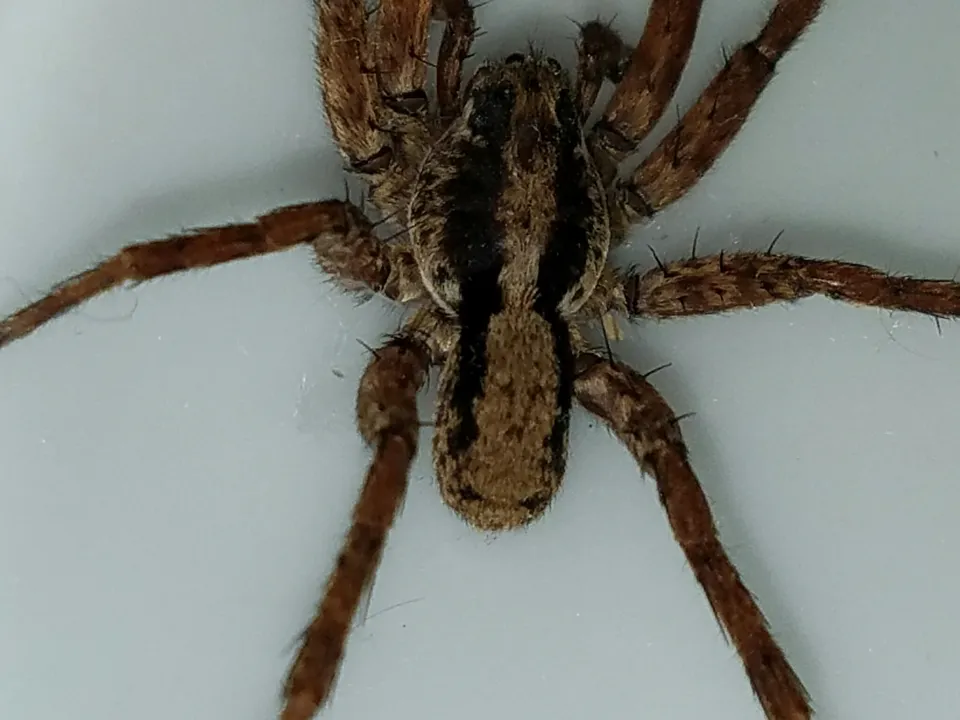
Wolf spiders are among the spiders most often mistaken for brown recluses, and Kentucky points out that the banding on a wolf spider's legs is one sign it is not a recluse. Wolf spiders are hunting spiders that run on the ground instead of catching prey in webs, and they often wander indoors.
| Feature | Brown recluse | Wolf spider |
|---|---|---|
| Body length | About 1/4 to 1/2 inch | Often larger; the big house-invading species are about 5/8 to 1 3/8 inch (16 to 35 mm) |
| Color | Tan to dark brown, even | Brown to tan or dark brown with gray hairs, some with black markings |
| Legs | Thin, one color, no spines | Long and hairy; some species have lighter bands at the joints |
| Eyes | 6, in 3 pairs | 8, in 3 rows (4 small, 2 large, 2 small) |
| Eyes in a flashlight at night | Not used as a clue | Reflect green |
| Habits | Hides in dark, undisturbed spots by day, hunts at night | Runs on floors and ground, day and night |
| Females with young | Egg sacs kept in the retreat | Female carries the egg sac, then spiderlings ride on her abdomen |
Sizes for wolf spiders come from Penn State, which gives females of the two big species found in homes as 18 to 35 mm and males as 16 to 20 mm, with legs banded on one of them [5]. Clemson adds that small wolf spiders can be under 1 inch and some species reach 2 inches, and that the female attaches her egg sac to her abdomen [6]. UC IPM notes the green eyeshine when you search with a flashlight [7], and Utah State describes the eye pattern as four smaller eyes on the bottom, two large eyes in the center and two smaller eyes on top [8].
Wolf spiders may bite if handled or trapped against skin. Penn State says the usual reaction is brief pain and redness that fades within 24 hours. Read more in our wolf spider profile, and for other house spiders see the spiders overview.
Where do brown recluses live in the U.S.?
The brown recluse is native to the south-central and Midwestern U.S. UC IPM describes its range as running from southeastern Nebraska to southwestern Ohio and south through Texas to north Georgia [2]. Kentucky adds that recluses are rare outside their native range: a spider occasionally arrives in boxes or furniture, but infestations seldom become established.
That matters for identification. UC IPM says there are no brown recluse populations in California, even though many Californians report them; related recluse species live only in the state's southeastern deserts. If you live far outside the range, a brown spider in your home is very unlikely to be a recluse, which is why the decision chart below starts with location.
Where do brown recluses hide indoors?
Brown recluses hunt at night and spend the day in dark, undisturbed places. Kentucky lists closets, clothing, shoes, stored boxes, the spaces behind and beneath beds and furniture, and, in attics, basements and crawl spaces, along joists and rafters and under rolled insulation [1]. NC State adds bathrooms, cellars and storage areas.
Three clues besides the spider itself can confirm an infestation:
- Shed skins: Kentucky says recluse shed skins have a distinct outstretched look.
- Egg sacs: off-white silk sacs about 1/3 inch across, holding about 40 to 50 eggs.
- Webs: recluses do not hang webs to catch food. Webs strung across corners and ceilings almost always belong to harmless cobweb or cellar spiders.
Kentucky recommends flat sticky cards (glue traps) placed along baseboards and behind furniture as a way to find out whether recluses are present and where. Texas A&M notes that adults are seen most often in spring. Because these spiders are hard to eliminate, Kentucky says treatment is best done by professionals. For room-by-room checks, see our bedroom and bathroom pest guides.
What should you do if you think a brown recluse bit you?
Seek medical attention promptly if you think a brown recluse bit you; Kentucky and NC State both give that advice [3]. If you can, collect the spider, even crushed, so an expert can identify it. Kentucky notes that confirmation helps the doctor decide what to do.
Bites are uncommon. Kentucky says the brown recluse is not aggressive, that people can live in heavily infested buildings without being bitten, and that most bites happen when a spider is trapped against bare skin in clothing or bedding. A sore alone cannot prove a brown recluse bite, because bacterial infections and other conditions can look very similar. Our guide to spider bites covers which symptoms need emergency care.
Frequently Asked Questions
Are brown recluses aggressive?
No. The University of Kentucky says the brown recluse is not aggressive and bites mainly when pressed against skin, for example when someone rolls over one in bed or puts on clothing it was hiding in. Its fangs are very small and cannot bite through clothing [1].
Do brown recluses live in California?
No established populations are known. UC IPM says fewer than 20 verified brown recluse specimens have been collected in California over several decades. A few native relatives, mainly the desert recluse, live in the southeastern deserts of the state [2].
Do brown recluses make webs?
Only small, irregular silk retreats where they hide and make egg sacs. Kentucky says a brown recluse does not use a web to catch food, so webs in room corners and on ceilings almost always belong to other spiders.
Is a big hairy brown spider running across the floor a brown recluse?
Probably not. A large, hairy spider with banded legs that runs across the floor fits a wolf spider much better. A brown recluse is smaller, has thin legs without bands or spines, and usually stays hidden during the day. If in doubt, try our bug identifier or have the spider checked.
Our Take
We think the violin mark causes more confusion than it solves. Plenty of harmless brown spiders seem to have one, and UC IPM's experts say even professionals have seen violins that were not there. In our view the most useful checks are simpler: do you live in the south-central or Midwestern range, are the legs and abdomen plain with no bands or spines, and, if you can get a hand lens on it, are there 6 eyes in pairs instead of 8? A spider that fails any of those is almost certainly not a recluse. One that passes all three is worth having confirmed by your Cooperative Extension office before you worry further.
Sources
- Brown Recluse Spider (ENTFACT-631). University of Kentucky Entomology, 2026.
- Brown Recluse and Other Recluse Spiders. UC Statewide IPM Program, 2018.
- Spiders in and Around Homes. NC State Extension.
- Control of Brown Recluse Spiders (ENT-3003). Texas A&M AgriLife Extension.
- Wolf Spiders. Penn State Extension.
- Wolf Spiders. Clemson Cooperative Extension Home and Garden Information Center, 2001.
- Spiders. UC Statewide IPM Program.
- Don't Get Spooked If Spiders Creep Indoors This Fall. Utah State University Extension, 2023.
Pest activity and species vary by region. If you are unsure what you have, your local Cooperative Extension office can identify it. Always read and follow pesticide labels. Spotted an error? Tell us.
Keep Reading
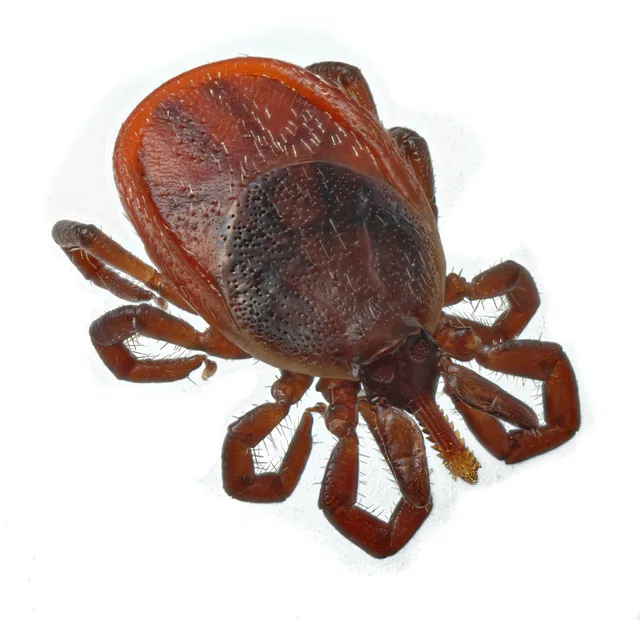
What Does a Tick Look Like? Common US Ticks Compared
What ticks look like: flat, 8-legged, teardrop-shaped arachnids. Compare blacklegged, lone star and American dog ticks by size, color, markings and season.
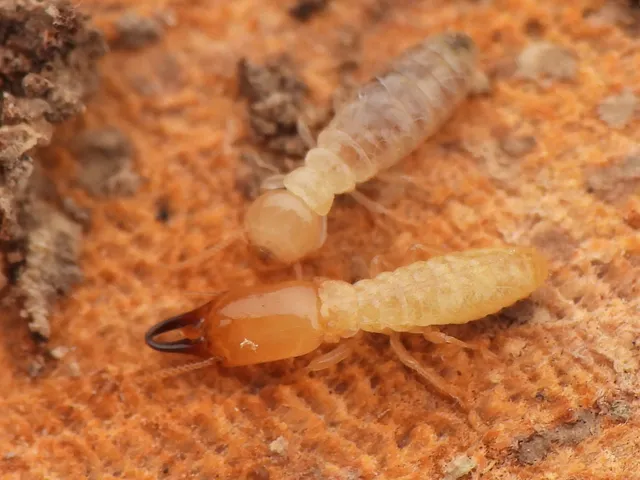
What Does a Termite Look Like? Termites vs Flying Ants
See what termites look like: creamy white workers, big-jawed soldiers and dark winged swarmers, and how to tell termites from flying ants by waist and wings.
What Does a Flea Look Like? Size, Color, and Signs
What a flea looks like: size, color and shape, plus flea eggs, larvae, cocoons and flea dirt, and how to tell fleas apart from bed bugs and carpet beetles.
What Does a Bed Bug Look Like? Every Life Stage
What bed bugs look like at every stage: apple-seed adults, pale nymphs and pinhead eggs, with a size scale, lookalikes like carpet beetles and signs to check.