What Does a Termite Look Like? Termites vs Flying Ants
Quick Answer
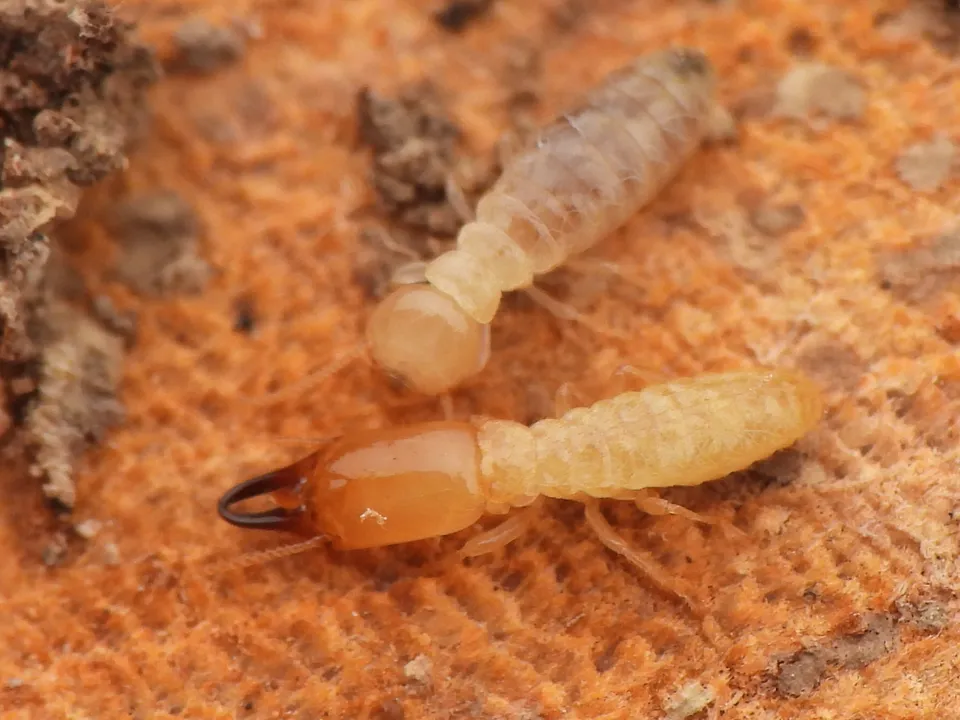
Termites come in three forms. Workers are small, soft and creamy white; soldiers look similar but have a long yellowish head with large jaws; swarmers are dark brown to black with four equal-length wings. To tell a winged termite from a flying ant, check three things: termites have straight antennae, a thick waist and equal wings, while ants have elbowed antennae, a pinched waist and smaller hind wings.
On this page
Key Takeaways
- Termite workers are creamy white and about 1/4 inch long; most people never see them because they stay inside wood and soil.
- Swarmers are the termites people notice: dark brown to black, with two pairs of translucent wings of equal length that break off easily.
- Termites have straight antennae, a broad waist and equal wings; flying ants have elbowed antennae, a narrow waist and hind wings smaller than the front wings.
- Winged termites or piles of shed wings inside the house almost always mean an infestation that needs a licensed professional inspection.
- Swarmers themselves do not damage wood and live only about a day.
What does a termite look like?
The answer depends on which member of the colony you find. The eastern subterranean termite, the species most homeowners deal with, has three main forms, and Penn State Extension describes each one [1]:
- Workers are creamy white, soft-bodied and rarely seen. They do all the feeding, so they are the ones that damage wood.
- Soldiers are about 1/4 inch long, with an elongated yellowish head and large jaws. They guard breaks in the colony's tunnels.
- Swarmers (winged kings and queens) are dark brown or black, 3/8 to 1/2 inch long, with two pairs of translucent wings of equal length that break off after the swarm.
If you see a pale, soft, ant-sized insect inside damaged wood, it is far more likely to be a termite worker than an ant.
The eastern subterranean termite is the most common termite species in North America [2]. The EPA adds that native subterranean termites are the most common type in most of the U.S., while drywood termites and the invasive Formosan termite are less common [4]. Formosan swarmers are attracted to lights and fly at dusk, according to UC IPM [6].
Why you rarely see the colony itself: it lives underground. NC State reports that an eastern subterranean termite queen typically lays 5,000 to 10,000 eggs a year, that mature colonies average about 300,000 members and can reach several million, and that a colony can take up to a decade to produce its first swarmers [2]. Workers reach wood in a house by building mud tubes over soil and foundation walls, which keep them moist and protected. That is why the winged swarmers, which leave the colony to mate, are often the first termites a homeowner ever sees.
How can you tell termites from flying ants?
Look at the antennae, the waist and the wings. Kentucky entomologist Michael Potter sums up the termite side this way: "Termites have straight antennae, a uniformly thickened waist, and wings of equal size" [3]. Ants have elbowed antennae, a pinched waist and front wings that are longer than the hind wings.
| Feature | Termite swarmer | Flying ant |
|---|---|---|
| Antennae | straight, beadlike | elbowed, bent like an L |
| Waist | broad, no pinch | narrow, pinched |
| Wings | 4 wings of equal size | front wings larger than hind wings |
| Wing length | about twice the body length | about the body length |
Wing length comparison from Penn State Extension [1]; antennae, waist and wing shape from NC State Extension and UC IPM [5]. Both insects drop their wings after a swarm, so a wingless insect still needs the antennae and waist check.
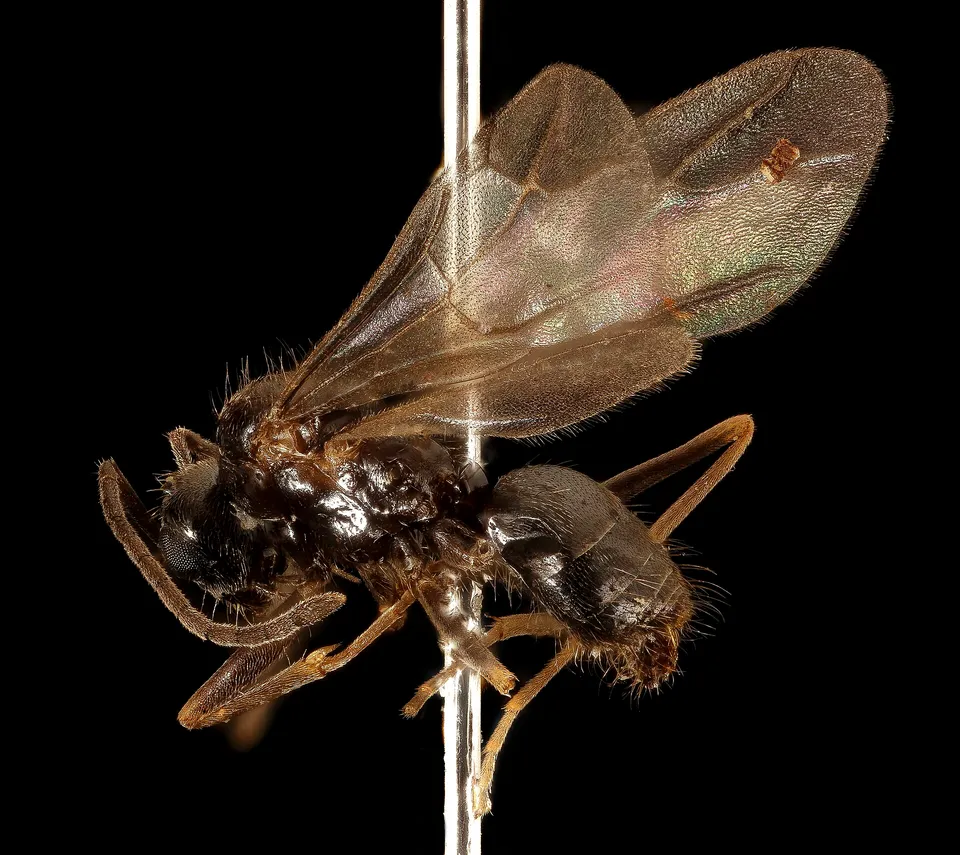
Carpenter ants cause the most confusion, because they also live in wood. Penn State notes that carpenter ant workers are shiny dark brown to black with elbowed antennae, while termite workers are creamy white with straight, beadlike antennae [8]. The damage looks different too. Carpenter ants push coarse, stringy wood shavings out of their nests, often mixed with insect parts, and their galleries are smooth and free of soil; carpenter ants dig in wood but do not eat it. Termite galleries follow the grain and are lined with dried soil. If you find ants, see how to get rid of ants.
How big are termites?
Termites are small. Workers and soldiers are about 1/4 inch long, and swarmers are 3/8 to 1/2 inch including their wings [1]. NC State measures eastern subterranean swarmers at roughly 8 to 10 mm from head to wingtip [2]. Carpenter ant workers, by comparison, run about 1/4 to 1/2 inch, and their winged reproductives reach about 3/4 inch, according to Penn State.
When do termites swarm, and what does a swarm indoors mean?
Swarming season depends on where you live. In Pennsylvania, swarms usually appear between February and June, most often in late winter or early spring [1]. In North Carolina, eastern subterranean termites usually swarm from late spring to late summer on warm days after rain, and can swarm earlier or later depending on the weather [2]. Swarmers are drawn to light, so indoors they gather at windows and doors.
Where the swarm comes from matters. The University of Kentucky says "Discovering winged termites indoors almost always indicates an infestation warranting treatment," while a swarm from a stump or woodpile in the yard does not automatically mean the house is infested; swarmers coming up next to the foundation or from an attached porch are a stronger warning [3].
Winged termites or piles of their shed wings inside your home are a reason to book a licensed professional inspection, not a reason to panic.
Penn State notes that shed wings are often the only sign of termites in a building [1]. Sweep up a few wings or bodies and keep them in a sealed bag or jar so an inspector can confirm what they are.
What other signs show termites are in your house?
Most people never see a termite worker, because they stay hidden. Kentucky calls termites "cryptic creatures" whose infestations "can go undetected for years," and lists these clues [3]:
- Mud tubes about as thick as a pencil on foundation walls, piers, sill plates or joists. Breaking one open may show small, creamy white workers, though an empty tube does not prove the colony is gone.
- Damaged wood hollowed out along the grain, with dried soil lining the galleries.
- Tiny holes in drywall or plaster with soil around the edges, or rippled wall coverings.
Penn State adds that wood touching soil or concrete floors is especially at risk, as are areas near furnaces, water heaters and hot water pipes [1]. The EPA suggests probing exposed wood for hollow spots with a flathead screwdriver [4].
Drywood termites, which live inside wood without soil contact, leave different clues: small kickout holes and hard fecal pellets with six sides and ridges along their length [7]. UC IPM describes them mainly in California, so subterranean signs are what most U.S. homeowners should watch for.
Other wood damage has other causes. Large round holes about 1/2 inch across in bare outdoor wood point to carpenter bees, not termites.
What should you do if you think you have termites?
Stay calm and get an expert to look. Kentucky notes that termites damage wood slowly, so taking time to choose a company usually does not cause much additional harm [3]. These steps help:
- Keep a sample of swarmers or wings in a sealed bag, and take clear photos of any mud tubes or damaged wood so every inspector sees the same evidence.
- Do not break open every mud tube or try to treat the area yourself; an inspector needs to see the activity.
- Have a licensed pest management professional inspect the house. The EPA says firms offering termite services must be licensed by the state, and you can ask to see the license [4].
- Get inspections and estimates from more than one company before signing.
Our guide on how to get rid of termites compares professional treatments and explains what a homeowner can safely do alone. For other insects, try the bug identifier tool or browse the identification guides.
Frequently Asked Questions
Can termite swarmers damage my house?
No. The University of Kentucky says swarmers emerging inside a home "are incapable of damaging wood and only live for about a day" [3]. You can sweep or vacuum them. The concern is the colony they came from, which needs an inspection.
What are the small white bugs in my wood?
Soft, creamy white insects inside damaged wood are most likely termite workers. Penn State describes workers as creamy white and rarely seen, the caste that does the feeding [1]. Have the wood inspected by a licensed professional.
Are flying ants a sign of termites?
Not by themselves. Flying ants are ants; UC IPM notes that winged ants leave their nests in warm weather and are often mistaken for termites. Check the waist, antennae and wings using the table above; if any winged insects are termites, or you cannot tell, schedule a professional inspection.
Our Take
We think the single most useful thing a homeowner can learn here is the waist check. It takes seconds, needs no magnifier for most swarmers, and sorts the scary case from the common one. Based on the extension guidance we used, a few flying ants in spring are usually a nuisance, while winged termites indoors are a clear signal to call a licensed inspector. We would also push back on panic: Kentucky's advice that termite damage happens slowly is a good reason to compare companies calmly rather than sign the first contract offered. Save a sample, take photos, and let a professional confirm what you have.
Sources
- Eastern Subterranean Termites. Penn State Extension, 2014.
- Biology and Behavior of Eastern Subterranean Termites. NC State Extension, 2025.
- Termite Control: Answers for Homeowners (ENTFACT-604). University of Kentucky Entomology, 2026.
- Termites: How to Identify and Control Them. U.S. Environmental Protection Agency, 2026.
- Ants: Pest Notes for Home and Landscape. UC Statewide IPM Program, 2012.
- Subterranean and Other Termites. UC Statewide IPM Program, 2014.
- Drywood Termites. UC Statewide IPM Program, 2014.
- Carpenter Ants. Penn State Extension, 2014.
Pest activity and species vary by region. If you are unsure what you have, your local Cooperative Extension office can identify it. Always read and follow pesticide labels. Spotted an error? Tell us.
Keep Reading
What Does a Tick Look Like? Common US Ticks Compared
What ticks look like: flat, 8-legged, teardrop-shaped arachnids. Compare blacklegged, lone star and American dog ticks by size, color, markings and season.
What Does a Flea Look Like? Size, Color, and Signs
What a flea looks like: size, color and shape, plus flea eggs, larvae, cocoons and flea dirt, and how to tell fleas apart from bed bugs and carpet beetles.
What Does a Brown Recluse Look Like?
How to recognize a brown recluse: a plain tan to brown spider with even-colored legs and 6 eyes in 3 pairs, why the violin mark misleads, and wolf spider tips.
What Does a Bed Bug Look Like? Every Life Stage
What bed bugs look like at every stage: apple-seed adults, pale nymphs and pinhead eggs, with a size scale, lookalikes like carpet beetles and signs to check.