How to Get Rid of Carpenter Bees
Quick Answer
To get rid of carpenter bees, make your wood unattractive to them: paint or varnish bare, weathered wood, replace badly tunneled boards, and fill old holes with wood putty, caulk or glued dowels in the fall. If bees are actively nesting, a labeled insecticide can be applied into the open holes in spring, then plugged a few days later. Males cannot sting, and the bees are pollinators.
On this page
- How do you get rid of carpenter bees, step by step?
- How do you know you have carpenter bees and not bumble bees?
- What is going on inside a carpenter bee hole?
- Are carpenter bees dangerous, and should you kill them?
- When is the best time to deal with carpenter bees?
- Should you use insecticide on carpenter bee holes?
- When should you call a pest professional?
- Frequently Asked Questions
- Our Take
- Sources
Key Takeaways
- Carpenter bees drill a nearly perfect round hole about 1/2 inch wide into bare, weathered softwood such as pine, cedar, cypress and redwood.
- Paint is the most durable protection; stains and preservatives repel them less reliably.
- Fill old holes in fall after the bees are done, then paint or varnish over the patch so the tunnels are not reused next spring.
- The hovering males cannot sting, and females rarely sting unless handled. The bees also pollinate garden flowers.
- Damage from one bee is small, but tunnels reused year after year can weaken wood, so act before a board has many holes.
How do you get rid of carpenter bees, step by step?
Start with the wood, not the bees. University of Kentucky entomologist Michael Potter notes that carpenter bees "usually will not tunnel into painted wood," and that painting unfinished wood with a history of attack is the most durable option [2]. Here is the order we suggest, based on extension guidance:
- Find every hole. Look under eaves, fascia boards, deck rails, porch ceilings, window trim and wooden outdoor furniture. Coarse sawdust on the ground and stains below a hole point to an active nest.
- Paint or varnish bare wood. Illinois Extension recommends painting or varnishing exposed wood because the bees prefer raw wood [3]. Kentucky says stains and preservatives are less reliable than paint.
- Fill old holes in the fall. Penn State advises filling holes in fall with wood putty or wooden dowels and then painting or varnishing the surface [1]. By then the new adults have settled in for winter, and a sealed, painted board is less inviting next spring.
- Replace the worst boards. Where a board is riddled with tunnels, Illinois suggests replacing it with painted wood or a non-wood material such as composite, vinyl or aluminum.
- Close up during nest hunting. Kentucky notes that bees searching for nest sites usually slow down by late spring, so keeping garages and sheds closed during that time helps.
Painting bare wood and filling old holes in the fall prevent more carpenter bee damage than anything you can spray.
How do you know you have carpenter bees and not bumble bees?
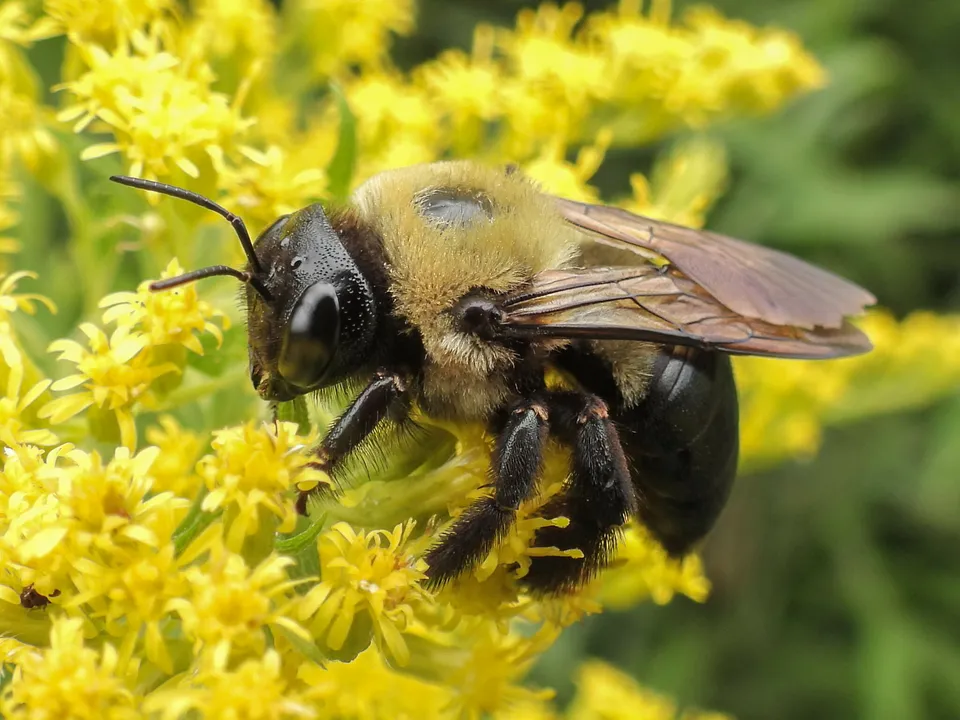
Carpenter bees look like bumble bees, which is why so many people are unsure what is drilling their deck. The quickest check is the back half of the body. Penn State explains that the top of a carpenter bee's abdomen is largely hairless and shiny black, while a bumble bee's abdomen is covered in hair [1]. Bumble bees nest in the ground; carpenter bees nest in wood.
The signs on your house are just as telling:
| Sign | What it looks like | Source |
|---|---|---|
| Entry hole | Nearly perfectly round, about 1/2 inch across, about the width of your little finger | Penn State, Kentucky |
| Sawdust | Coarse sawdust on the ground or deck right below the hole | Kentucky |
| Stains | Streaks on the surface below the opening, from bee droppings | Penn State, Illinois |
| Hovering bees | Large black bees darting around eaves and decks in spring | Penn State |
| Woodpecker damage | Torn-up wood around old holes where birds dug for larvae | Illinois |
Eastern carpenter bees are about 3/4 to 7/8 inch long, similar in size to bumble bees [3]. Males have a whitish spot on the face; females have an all-black face. If you are not sure what you are seeing, our bug identifier tool and the carpenter bee profile can help.
What is going on inside a carpenter bee hole?
Carpenter bees do not eat wood. A female chews a round hole straight in, then turns at a right angle and tunnels along the grain to make a nest [1]. Penn State says the turn comes after about 1 inch and that the bees prefer wood more than two inches thick. Inside, she builds a row of brood cells, stocks each with "bee bread" made of pollen and nectar, lays one egg on it and seals it. Penn State and Illinois count about 6 to 8 cells in a new nest; Kentucky says about five or six.
That shape explains why damage builds up slowly. Kentucky says a single nest is seldom as destructive as termites, but significant damage can occur when the same pieces of wood are infested year after year, and holes let in moisture that leads to rot [2]. Illinois adds that woodpeckers may tear into the wood hunting for larvae. If the damaged wood instead has mud-lined galleries or crumbles in layers, it may be termites, which need a very different plan.
Are carpenter bees dangerous, and should you kill them?
Not usually. Male carpenter bees are the ones that hover in your face near the nest, but Penn State states plainly that "the male bee cannot sting" [1]. Females can sting, but Penn State says she "must be extremely provoked (i.e., handled)" first, and Kentucky adds that carpenter bees are less inclined to sting than wasps and social bees.
The big black bee chasing you around the deck is almost always a male, and males have no stinger.
They also do some good. Illinois Extension calls carpenter bees beneficial pollinators that visit many flowers, "particularly large open-faced flowers such as sunflowers, coneflowers, and asters" [3]. That is a good reason to protect the wood you care about rather than try to wipe out every bee. Illinois even suggests leaving tree stumps (with the bark removed) or logs as other places for them to nest, away from the house. See our garden pest guide for other insects you will meet outdoors.
Anyone who has had a serious allergic reaction to a bee or wasp sting should keep their distance from nests and let someone else do the work.
When is the best time to deal with carpenter bees?
Timing matters more than the product. Illinois Extension says the bees spend the winter as young adults inside the tunnels, then emerge and mate in April and May, when females clean out old tunnels or dig new ones. New adults emerge in August or September, feed, and return to the tunnels to overwinter [3].
| Season | What the bees are doing | What you can do |
|---|---|---|
| Spring (April to May) | Emerging, mating, drilling new holes | Watch for new holes; treat active tunnels only if needed |
| Summer | Females raising young; new adults appear late summer | Plan repairs; Penn State suggests a mid-summer follow-up if you treat |
| Fall | New adults settle into tunnels for winter | Fill holes with putty, caulk or dowels, then paint or varnish |
| Winter | Adults resting in tunnels | Replace badly damaged boards before spring |
Kentucky stresses that control works best before tunnels are fully built, so spring is the window for treatment and fall is the window for sealing [2].
Should you use insecticide on carpenter bee holes?
Only if non-chemical steps are not enough and bees are actively nesting in wood you need to protect. The extension approach is targeted: treat the individual tunnel openings, not the whole yard. Kentucky describes applying a liquid, aerosol or dust product labeled for carpenter bees into the hole, leaving the hole open for a few days so returning bees pass through it, then plugging it with a glued wooden dowel, putty or sealant [2]. Illinois says to plug holes about a week after treatment, and Penn State warns not to plug them right away.
Read and follow the label. The label is the law. Use only an EPA-registered product whose label lists carpenter bees and the site you are treating, keep every spray and dust away from children and pets, and store products in their original containers out of reach. Penn State recommends gloves, goggles, protective clothing and a dust mask or respirator, washing contaminated clothing separately, and keeping products out of streams, ponds and plants that animals feed on [1]. Because females may sting when their nest is disturbed, Kentucky suggests working at dusk.
Treat only the holes bees are using, never flowering plants, and seal the hole once the bees are gone.
Kentucky also describes simple traps: a small wooden box with 1/2 inch holes and a bottle underneath, hung under eaves in early spring. They catch some bees but do not replace painting and sealing.
When should you call a pest professional?
Most carpenter bee problems on a deck rail or a low fascia board are a weekend job. Call a licensed pest professional when:
- The holes are high up in eaves, soffits or rooflines that you cannot reach safely from the ground. Penn State notes that many homeowners hire licensed pest control for eaves and soffits [1].
- Many boards are riddled with holes or the wood feels soft, which can mean years of reuse or rot behind the surface.
- Someone in the home is allergic to stings and should not be near active nests.
- You are not sure it is carpenter bees. Damage with mud tubes or soil in the galleries points to termites, and that calls for an inspection. Our termite guide explains why.
For other wood and yard pests, browse all of our How to Get Rid Of guides. Large black ants with piles of wood shavings are a separate problem covered in how to get rid of ants.
Frequently Asked Questions
Do carpenter bees sting?
Males cannot sting, even though they hover close and seem aggressive. Females can sting, but Penn State says they must be extremely provoked, such as being handled, before they will [1].
Will painting my wood stop carpenter bees?
Painting is the most durable protection. Kentucky says carpenter bees usually will not tunnel into painted wood, and that stains and preservatives are less reliable [2]. Paint over filled holes too.
Should I plug carpenter bee holes right away?
Not if you are treating the holes. Leave them open for a few days to about a week so the bees pass through the treatment, then plug them. If you are not treating, the best time to fill old holes is in the fall, per Penn State.
Our Take
We think carpenter bees are more of a wood maintenance problem than a bug problem. The extension guidance we relied on agrees that bare, weathered softwood is what attracts them, and that paint is the most durable fix. So our advice is to spend your effort on the house: paint or varnish the boards they love, fill old holes in the fall, and replace the worst boards with painted wood or non-wood trim. Use a labeled insecticide only on active holes you cannot otherwise protect, and leave the flowers alone. The hovering males are harmless, and the bees pollinate the garden. For high eaves or badly damaged wood, we would call a licensed professional.
Sources
- Carpenter Bees. Penn State Extension, 2014.
- Carpenter Bees (ENTFACT-611). University of Kentucky Entomology, 2026.
- Carpenter bees: destroyers of wood or beneficial pollinators?. Illinois Extension, 2023.
Pest activity and species vary by region. If you are unsure what you have, your local Cooperative Extension office can identify it. Always read and follow pesticide labels. Spotted an error? Tell us.
Keep Reading
How to Get Rid of Mosquitoes in Your Yard
Get rid of yard mosquitoes at the source: dump standing water weekly, clean gutters, cover rain barrels, treat ponds, keep screens tight and call local control.
How to Get Rid of Stink Bugs Indoors
Get rid of stink bugs indoors without the smell: vacuum or drop them in soapy water, never crush them, and seal cracks before fall, when they move inside.

How to Get Rid of Silverfish
Get rid of silverfish by drying out damp rooms, fixing leaks, clearing old paper and boxes, and catching them in simple jar traps. See when dusts or a pro help.
How to Get Rid of Drain Flies
Get rid of drain flies by finding the breeding drain with a cup test, then scrubbing out the slimy film. Boiling water and bleach fail; here is what works.
How to Get Rid of Fleas in the House
Get rid of fleas in the house: have your vet treat every pet, vacuum daily, wash pet bedding, treat flea hot spots and keep at it for weeks while cocoons hatch.

How to Get Rid of Termites: DIY vs Professional
Termites in your house need a licensed pro, but you can spot the signs, fix moisture and wood-to-soil contact, and choose a company wisely. Here is what helps.