How to Get Rid of Stink Bugs Indoors
Quick Answer
To get rid of stink bugs indoors, vacuum them up or brush them into a container of soapy water, and do not crush them, which releases the smell. Then find where they are coming out (baseboards, window trim, light fixtures) and seal those gaps. For next year, caulk cracks around windows, doors, siding and pipes before September, when stink bugs start looking for a place to spend the winter.
On this page
- How do you get rid of stink bugs in the house right now?
- Is it really a brown marmorated stink bug?
- Why are stink bugs in my house, and when do they come in?
- How do you keep stink bugs out of the house?
- Do stink bug sprays, foggers or traps work?
- Are stink bugs harmful, and when should you call a professional?
- Frequently Asked Questions
- Our Take
- Sources
Key Takeaways
- The stink bug in most U.S. homes is the brown marmorated stink bug, an invasive insect that moves indoors in fall to spend the winter.
- It does not bite, breed indoors or damage the house; the problem is the smell and the numbers.
- Vacuuming or soapy water removes the bugs you see; crushing them makes the odor worse.
- Sealing cracks before September is the only step that keeps them out, and extension experts call it the best method.
- Indoor sprays and foggers are not recommended; a licensed pest professional can help with large numbers or hard-to-reach walls and attics.
How do you get rid of stink bugs in the house right now?
The bugs already inside are best removed by hand, one batch at a time. University of California IPM says vacuuming works well, that you can brush single bugs into a container of soapy water, and that live bugs sealed in a bag can be frozen for 2 days [2]. Here is how to do each one without stinking up the room:
- Vacuum them. A hand-held or shop vacuum picks up live and dead bugs from walls, ceilings and window frames. UC IPM notes that some people slip a nylon stocking into the vacuum tube to catch the bugs before they reach the bag. Penn State warns that the vacuum may keep a stink bug smell for a while afterward, which is why UC IPM mentions that some people keep a separate vacuum just for stink bugs [1]. Empty it into an outdoor trash can, as University of Illinois Extension suggests [4].
- Use a soapy water jar. Fill a wide jar or tub partway with water and a little dish soap. Hold it under the bug and tap or brush the bug in. The soap breaks the surface tension, and the bug cannot climb out.
- Try a light trap in a dark room. UC IPM describes a foil pan of water with a few drops of dish soap placed under a lamp in a darkened room; the bugs fly toward the light and drown.
- Do not crush or flush them. A crushed stink bug releases its odor, and Penn State reports that crushing them on bare skin can cause a skin reaction in a small share of people. UC IPM advises against flushing them or putting live bugs in the trash.
The best way to remove a stink bug is to vacuum it or drop it in soapy water, never to squash it.
After you clear a room, watch where the next bugs appear. They tend to crawl out of cracks under or behind baseboards, around window and door trim, and around exhaust fans and ceiling lights [1]. Penn State recommends sealing those indoor openings with caulk so the bugs hiding in the walls cannot crawl out into the living space.
Is it really a brown marmorated stink bug?
Most stink bugs that pile into U.S. homes are brown marmorated stink bugs (Halyomorpha halys). Penn State describes adults as about 17 mm (0.66 inch) long, shield shaped, and brown on top and underneath [1]. UC IPM gives about 5/8 inch and points to the clearest clue: two white bands on each antenna [2]. University of Illinois Extension adds smooth "shoulders" and a black and white pattern along the edge of the abdomen [3].
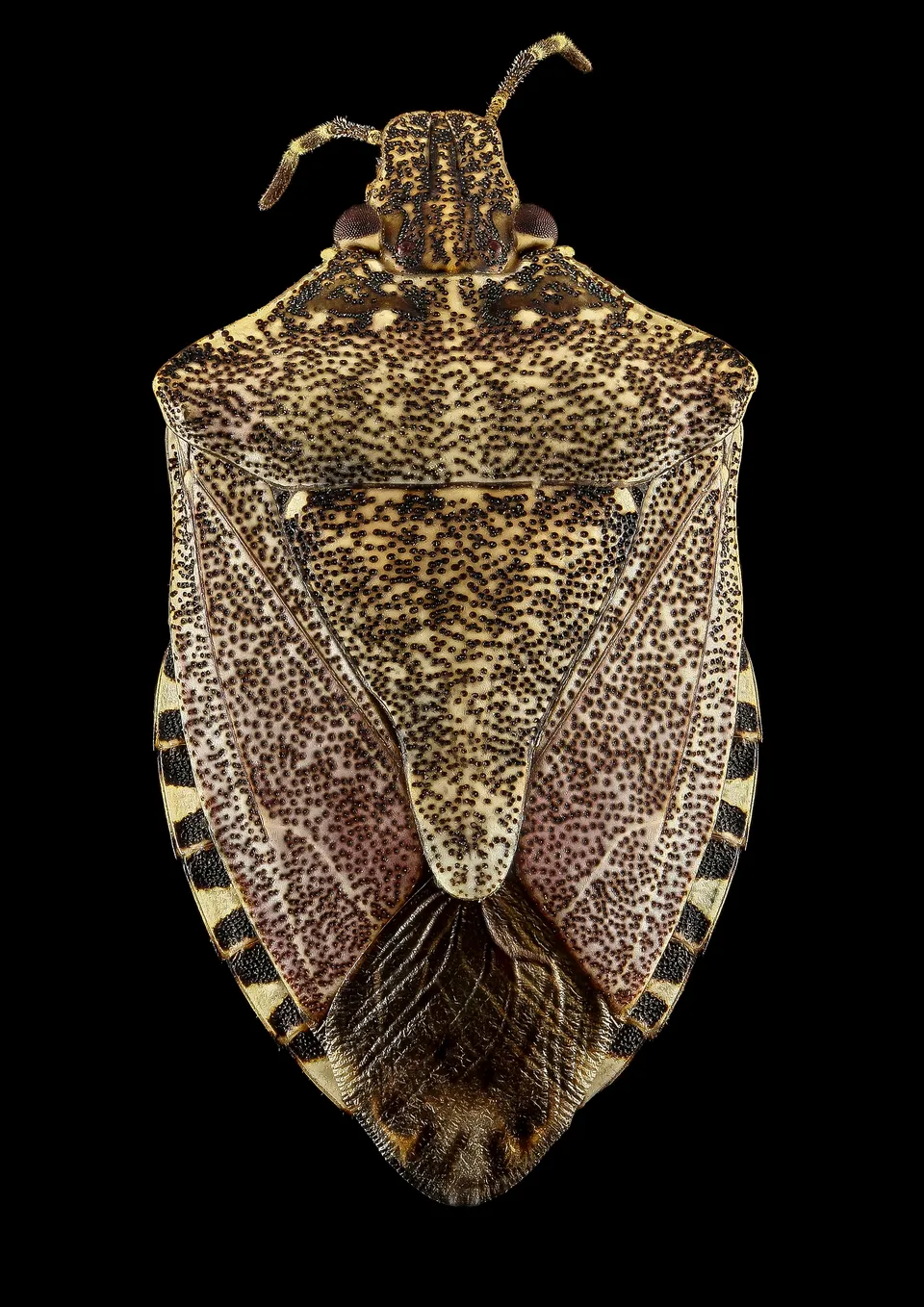
Several other bugs look similar, and the fix is much the same for all of them (vacuum, seal, wait for spring). Still, it helps to know what you have:
| Bug | Size | How to tell it apart |
|---|---|---|
| Brown marmorated stink bug | about 5/8 inch | white bands on the antennae, smooth shoulders, banded abdomen edge |
| Rough stink bug | similar | rough, toothed shoulder edge; no white antenna bands |
| Consperse stink bug | about 1/2 inch | smaller; banded abdomen edge but plain antennae |
| Boxelder bug | about 12 mm (1/2 inch) | flatter, brownish black, with three red-orange stripes behind the head |
Stink bug details from UC IPM [2]; boxelder bug details from Penn State [6]. If you are still unsure, try the bug identifier tool or read the stink bug profile and the boxelder bug profile.
Why are stink bugs in my house, and when do they come in?
Stink bugs come inside for shelter, not food. Penn State says adults begin searching for overwintering sites in September and October, and warm fall days draw them to the outside walls of houses, sometimes in large numbers [1]. They squeeze into wall voids, attics and other protected spaces and stay mostly still through the winter.
That is why you may see a few crawling on a window or buzzing around a lamp in December or February. University of Illinois Extension explains that the warmth of the house confuses the bugs and breaks their winter rest, and that they do not feed or reproduce while they are inside [4]. In spring, adults leave to find host plants. Penn State puts that emergence in late April to mid May, followed by egg laying from May through August.
The bug itself is an invasive species from East Asia. University of Illinois Extension says it was first reported in the United States in Allentown, Pennsylvania, in 1998 and has spread to more than 40 other states [3]. The StopBMSB research project reports it had been detected in 47 states and 4 Canadian provinces as of 2021, with the greatest crop damage in the mid-Atlantic region [5]. Detection does not mean every state has large numbers; home invasions are most common where the bug is well established.
How do you keep stink bugs out of the house?
Sealing is the step that actually prevents the problem. Penn State calls mechanical exclusion the best method to keep stink bugs from entering homes and buildings. It recommends good quality silicone or silicone-latex caulk for cracks around windows, doors, siding, utility pipes, behind chimneys and under wood fascia, and repairing or replacing damaged screens [1]. UC IPM adds foam sealant, weatherstripping, screening over gable vents, and gaps around air conditioners and vents [2].
A few practical points make sealing work better:
- Do it in late summer. Penn State's timeline puts the home invasion in September and October, so August is the time to caulk.
- Work from the top down. UC IPM notes stink bugs prefer high, cool hiding spots, so roof edges, soffits, attic and gable vents matter as much as windows.
- Check the inside too. Caulking around baseboards, window trim, ceiling lights and exhaust fans keeps bugs that are already in the walls from reaching your rooms.
- Turn down outdoor lights. UC IPM says the bugs gather around lights at night, so fewer lights near doors and windows mean fewer bugs at the gaps.
University of Illinois Extension admits the job is hard because the bugs squeeze through very small cracks [4]. Even partial sealing cuts the numbers, and every gap closed this year stays closed. The same steps also keep out other fall invaders, which our living room pest guide covers.
Do stink bug sprays, foggers or traps work?
Mostly no, at least indoors. UC IPM states that indoor sprays are not recommended because they are generally ineffective. Penn State goes further: it is not advisable to use an insecticide inside once bugs are in wall voids or the attic, and sprays aimed into cracks and crevices will not stop the bugs from coming out [1]. It also notes two side effects:
- Foggers kill the bugs that are on walls and ceilings at that moment, but more tend to emerge afterward, so they are not a long-term fix. The National Pesticide Information Center adds that foggers do not reach into the voids, cracks and crevices where pests hide, and that fogger contents can catch fire and explode, so pilot lights and other ignition sources must be off [7].
- Dusts in wall voids may kill many bugs, but the dead bugs can feed carpet beetles, which can then damage wool and stored goods. Read about carpet beetles if you see small round beetles on window sills.
Outdoors, the picture is only slightly better. UC IPM says sprays around entry points may deter bugs for a short time but break down within days, and sealing works better [2]. Penn State says exterior treatments may give minor relief where full sealing is hard, applied by a licensed pest control operator in the fall just before the bugs gather. If you or a professional use any insecticide, use only an EPA-registered product labeled for that site and pest. Read and follow the label. The label is the law. Keep children and pets away from treated areas until the label says it is safe.
What about traps? UC IPM says pheromone traps are useful for monitoring when the bugs are present or peaking, but catching many bugs does not mean the problem is solved. The light-and-soapy-water pan described above is a simple indoor option that uses no pesticide.
Are stink bugs harmful, and when should you call a professional?
Stink bugs are a nuisance, not a danger. UC IPM states that brown marmorated stink bugs are not harmful to people, houses or pets and that they do not bite, sting, suck blood or spread diseases to people or pets [2]. Penn State adds that they will not reproduce inside or damage the structure. The main health issue is the smell: Penn State notes the defensive odor can cause allergy symptoms such as a runny nose or itchy eyes in sensitive people, especially those also sensitive to cockroach or lady beetle odors [1]. If you have allergy symptoms that do not settle, talk to a doctor.
Most households can manage with a vacuum, a soapy water jar and a caulk gun. Call a licensed pest professional when:
- Hundreds of bugs keep coming out of walls, ceilings or the attic even after you seal the indoor openings.
- The gaps are high or hard to reach, such as soffits, roof edges and chimneys, and you cannot work safely on a ladder.
- You want an exterior treatment in early fall. Penn State recommends that these be applied by a licensed pest control operator.
- Someone in the home reacts badly to the odor and you need the numbers down quickly.
Spraying inside the house will not end a stink bug problem; sealing the outside of the house will.
For more fall and winter invaders, browse our How to Get Rid Of guides, check the garden pest guide for what stink bugs do outdoors, or see the full pest library.
Frequently Asked Questions
Do stink bugs lay eggs in the house?
No. Penn State and UC IPM both state that brown marmorated stink bugs do not reproduce inside buildings [1]. They lay eggs on plants outdoors from May through August. The bugs you see indoors are adults waiting for spring.
Why do I see stink bugs in the middle of winter?
The warmth inside your home wakes them from their winter rest, according to University of Illinois Extension [4]. They wander toward windows and lights, but they do not feed or breed. Vacuum them and seal the crack they came from.
Is it OK to flush stink bugs down the toilet?
UC IPM advises against flushing them [2]. Drop them in a container of soapy water instead, or vacuum them and empty the vacuum outdoors.
Do stink bugs bite people or pets?
No. UC IPM says they do not bite, sting or suck blood. If something is biting you indoors, it is a different pest; our bite identifier can help narrow it down.
Our Take
We think the stink bug problem is won or lost in August, not in November. Once the bugs are tucked into wall voids and attics, the extension guidance we relied on is clear that sprays, dusts and foggers do little, and some make things worse. What works indoors is unglamorous: a dedicated vacuum, a jar of soapy water and patience until spring. What works for next year is a caulk gun, a weekend before September, and attention to the high spots, such as soffits, vents and the chimney. We would call a licensed professional only for large numbers in hard-to-reach places or for a carefully timed exterior treatment, not as a substitute for sealing.
Sources
- Brown Marmorated Stink Bug. Penn State Extension, 2026.
- Brown Marmorated Stink Bug: Pest Notes for Home and Landscape. UC Statewide IPM Program, 2014.
- Brown Marmorated Stink Bug. University of Illinois Extension.
- Unwanted wintertime house guests. University of Illinois Extension, 2025.
- Where Is BMSB?. StopBMSB.org, 2021.
- Boxelder Bug. Penn State Extension, 2026.
- Total Release Foggers. National Pesticide Information Center, 2025.
Pest activity and species vary by region. If you are unsure what you have, your local Cooperative Extension office can identify it. Always read and follow pesticide labels. Spotted an error? Tell us.
Keep Reading
How to Get Rid of Mosquitoes in Your Yard
Get rid of yard mosquitoes at the source: dump standing water weekly, clean gutters, cover rain barrels, treat ponds, keep screens tight and call local control.
How to Get Rid of Silverfish
Get rid of silverfish by drying out damp rooms, fixing leaks, clearing old paper and boxes, and catching them in simple jar traps. See when dusts or a pro help.
How to Get Rid of Drain Flies
Get rid of drain flies by finding the breeding drain with a cup test, then scrubbing out the slimy film. Boiling water and bleach fail; here is what works.
How to Get Rid of Fleas in the House
Get rid of fleas in the house: have your vet treat every pet, vacuum daily, wash pet bedding, treat flea hot spots and keep at it for weeks while cocoons hatch.

How to Get Rid of Termites: DIY vs Professional
Termites in your house need a licensed pro, but you can spot the signs, fix moisture and wood-to-soil contact, and choose a company wisely. Here is what helps.
How to Get Rid of Carpenter Bees
Get rid of carpenter bees by painting bare wood, filling old holes in fall, and treating only active tunnels if needed. Males can't sting, and bees pollinate.