How to Get Rid of Termites: DIY vs Professional

Quick Answer
To get rid of termites in a house, have a licensed pest professional inspect and treat it; extension entomologists and the EPA agree that do-it-yourself products seldom wipe out an established colony. What you can do yourself is spot the signs early, cut off moisture, remove wood that touches the soil, keep mulch and firewood away from the foundation, and compare more than one company before you sign.
On this page
Key Takeaways
- Winged termites, shed wings, pencil-wide mud tubes and hollow wood lined with soil are the main signs; winged termites indoors almost always mean an infestation.
- Treating a house for termites is a job for a licensed professional. Retail products seldom eliminate an existing problem.
- Homeowners can make the house less inviting: fix leaks, send water away from the foundation, keep wood off the soil, and use mulch sparingly.
- Professionals mainly use liquid soil treatments, bait stations, or both; baits can take months.
- Termites work slowly, so take time to get inspections and estimates from more than one licensed company.
Can you get rid of termites yourself?
For termites in your house, no, not reliably. University of Kentucky entomologist Michael Potter writes that ridding a home of termites "requires special skills," including knowledge of building construction and specialized equipment, and that retail do-it-yourself products "will seldom eradicate an existing termite problem" [2]. A professional treatment can involve hundreds of gallons of termiticide placed in the soil along and under the foundation.
The other sources we checked say the same thing:
- EPA: "In most cases, termiticide application can only be properly performed by a trained pest management professional," and many termiticides are highly toxic [1].
- Penn State Extension: "We do not recommend that homeowners attempt to treat their own homes," because of the products, equipment and skill needed to build a continuous treated barrier [4].
- UC IPM: it is unlikely that homeowners can control subterranean termites on their own [5].
The do-it-yourself part of termite control is finding the signs and fixing the conditions; the treatment itself belongs to a licensed professional.
Kentucky notes one narrow exception: a small wooden object that is not attached to the house, such as a mailbox post, can be handled by the owner, for example by replacing it. Everything attached to the structure needs an inspection.
What are the signs of termites in a house?
Most people never see the termites themselves. EPA notes that most homeowners do not know they have termites until they see a swarm or find damage during construction or remodeling [1]. Look for these signs:
| Sign | What it looks like | Where to look |
|---|---|---|
| Swarmers | Small dark insects with four equal-length wings, often near windows, doors and lights | Windowsills, door frames, basements |
| Shed wings | Piles of small, equal-size wings with no insects attached | Windowsills, floors near walls |
| Mud tubes | Earth-colored tubes about the width of a pencil running up from the ground | Foundation walls, piers, sill plates, joists |
| Damaged wood | Wood hollowed out along the grain, with dried mud or soil lining the tunnels | Sills, joists, door and window trim |
| Wall clues | Tiny holes in drywall or plaster ringed with soil, or rippled wall coverings | Lower walls, near baseboards |
Signs from the University of Kentucky and Penn State Extension. Kentucky states that "discovering winged termites indoors almost always indicates an infestation warranting treatment" and that an empty mud tube does not prove the termites are gone [2]. Penn State adds that "very often the shed wings are the only evidence that termites are in a building" [4].
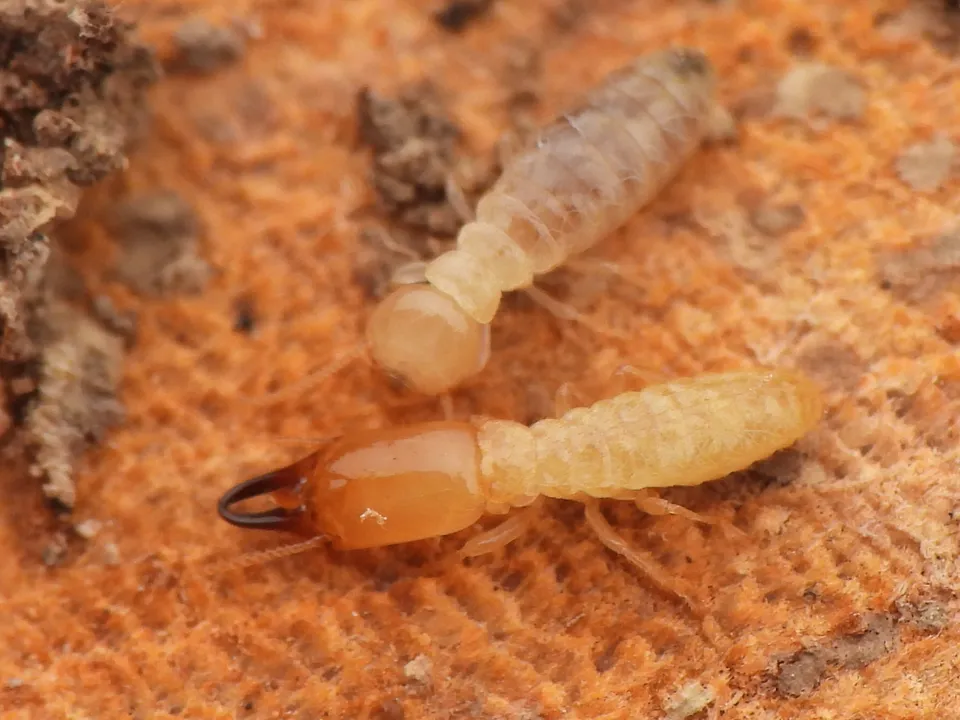
Winged ants are easy to mistake for termites. EPA describes termite wings as roughly equal in length and termite antennae as straight, while ants have longer front wings and bent antennae. Our guide to what a termite looks like compares them side by side, and the termite profile covers range and season. You can also probe exposed wood in the basement or crawl space with a flathead screwdriver to feel for hollow spots, as EPA suggests.
What can homeowners do to keep termites away?
This is where your effort pays off. Subterranean termites need moisture and a path from the soil to wood, so prevention is about drying things out and breaking that contact. Kentucky's homeowner guide recommends keeping wood siding and door and window frames at least six inches above the ground, and UC IPM recommends keeping wood beneath the building at least 12 inches above the soil [3] [5].
| What to fix | What the sources recommend |
|---|---|
| Water at the foundation | Keep gutters and downspouts working, add splash blocks, slope soil away from the house, and aim sprinklers away from the walls (Kentucky, EPA) |
| Leaks | Repair leaking faucets, pipes and air conditioning units right away (Kentucky, EPA) |
| Wood touching soil | Pull soil or mulch back, cut wood lattice off above the ground, set steps and posts on concrete, and replace wood in soil contact with pressure-treated or non-wood material (Kentucky, Penn State) |
| Mulch | Use it sparingly; Kentucky says "a couple inches is usually adequate," and mulch should never touch siding or door and window frames |
| Firewood and debris | Do not store firewood, lumber, cardboard or old form boards against the foundation or in the crawl space (Kentucky, EPA, Penn State) |
| Crawl space | Keep vents clear of plants and debris; Kentucky suggests covering much of the crawl space soil with plastic sheeting to cut moisture |
| Cracks | Seal foundation cracks and utility openings with cement, grout or caulk (EPA, Penn State) |
| Plants | Keep vines, ivy and dense shrubs from touching the house (Kentucky, EPA) |
Kentucky warns that pressure-treated wood can still be attacked, and that crushed stone and pea gravel hold moisture much like mulch [3]. Penn State also notes termites like the warm areas around furnaces, water heaters and hot water pipes in winter, so check those spots during your own walk-through.
Dry soil and a clear gap between wood and the ground make a house far less inviting to subterranean termites.
How do professionals get rid of termites?
Professionals mainly use one of two approaches, sometimes together. Both are applied under the label by trained, licensed applicators.
- Liquid soil treatments. The most common method. A termiticide labeled for this use is placed in the soil by trenching, soil injection or drilling through slabs to make a continuous treated zone between the colony and the wood [1]. Kentucky says liquid termiticides are supposed to control termites for at least five years when applied according to the label, and that termites showing up the year after treatment usually point to a gap in the barrier.
- Bait stations. Cellulose material laced with a slow-acting insecticide that foraging termites share with the colony. Kentucky warns that termites may take weeks or months to find the stations and months more to be controlled [2]. Penn State notes baits are especially useful near wells, springs, drain tiles and high water tables [4].
- Wood treatments and repairs. Borate wood treatments are often used during construction, and replacing damaged, wet wood is part of any fix. Penn State says combining structural fixes with chemical treatment often gives the most satisfactory results.
Drywood termites, which live in dry wood above ground and are less common than subterranean termites in most of the U.S. according to EPA, are handled differently. UC IPM describes localized injection of liquids, dusts or foams into galleries, and whole-structure fumigation when damage is widespread; both are professional jobs [5].
Read and follow the label. The label is the law. Ask the company for a copy of the product label; EPA says it should include directions for controlling termites, and the applicator should tell you when it is safe to return. Keep children and pets out of treated areas until then. If you think a pesticide was misapplied, contact your state pesticide regulatory agency, or call the National Pesticide Information Center at 1-800-858-7378 with questions.
How do you choose a termite company?
Slow down. Kentucky points out that termites damage wood slowly, so taking a few extra days or weeks to decide is generally inconsequential, and it advises avoiding firms "that try to pressure you into signing a contract immediately with specials or scare tactics" [2].
A short checklist built from the extension and EPA guidance:
- Check the license. EPA says firms offering termite services must be licensed by your state, and you can ask to see the license [1].
- Get more than one inspection. Kentucky says inspections from more than one company help confirm there is really an infestation and let you compare services. Penn State suggests at least three estimates and checking references.
- Ask how they will treat. Whole perimeter, spot treatment, baits or a combination. Kentucky calls spot treatments "usually a gamble."
- Read the warranty or service agreement. Most firms retreat at no extra charge only while the annual renewal is kept up, and Penn State notes warranties usually cover only subterranean termites.
- Ask for the product label and when you can safely go back into treated rooms.
Never let a scare tactic rush a termite contract; get a second licensed inspection first.
What should you do if termites swarm inside your house?
Stay calm. Kentucky says swarmers that emerge inside "are incapable of damaging wood and only live for about a day," and they can be cleaned up with a broom or vacuum [2]. The swarm is the warning sign, not the damage. Killing the swarmers does nothing about the colony in the soil.
What a swarm does mean is that an inspection is due. Winged termites indoors almost always point to an infestation; a swarm coming out of a stump or woodpile in the yard does not automatically mean the house is infested, but swarmers coming up next to the foundation or from an attached porch or patio suggest the house may be. Swarms usually come in spring; in Pennsylvania, Penn State says between February and June, and timing varies by region.
If you are still not sure what you found, compare it with our termite identification guide, try the bug identifier tool, or see how to get rid of carpenter bees and how to get rid of ants for the two pests most often blamed for wood damage. All of our pest guides are listed under How to Get Rid Of.
Frequently Asked Questions
Do termite swarmers mean my house is infested?
Winged termites inside the house almost always mean an infestation that needs treatment, according to the University of Kentucky. A swarm from a stump or woodpile in the yard does not automatically mean the house is infested, though it is a good reason to check the foundation and get an inspection [2].
How long does a professional termite treatment last?
Kentucky says liquid termiticides are supposed to control termites for at least five years when applied according to label directions, though results depend on the product, how thoroughly it was applied and local termite pressure. Baits work more slowly and need ongoing monitoring.
How often should I have my house inspected for termites?
UC IPM suggests regular inspections every 3 to 5 years to catch infestations before they become damaging, and more often for homes that have had termites before [5].
Can I treat termites with a store-bought product?
Not for termites in the house. Kentucky says retail do-it-yourself products seldom eliminate an existing termite problem, and EPA and Penn State recommend a trained, licensed professional for termiticide treatment.
Our Take
We think termites are the one common household pest where the best do-it-yourself step is picking up the phone. Every source we relied on, from EPA to Kentucky, Penn State and UC IPM, says treating a house belongs to licensed professionals, and we agree. That does not leave homeowners powerless. The work that actually lowers your risk is ordinary maintenance: clean gutters, water sent away from the foundation, no wood touching the soil, a thin layer of mulch, firewood stacked away from the walls. When you do find signs, take your time, get more than one licensed inspection, read the warranty, and walk away from anyone pushing you to sign today.
Sources
- Termites: How to Identify and Control Them. U.S. Environmental Protection Agency, 2026.
- Termite Control: Answers for Homeowners (ENTFACT-604). University of Kentucky Entomology, 2026.
- Protecting your Home Against Termites (ENTFACT-605). University of Kentucky Entomology, 2026.
- Eastern Subterranean Termites. Penn State Extension, 2014.
- Subterranean and Other Termites. UC Statewide IPM Program, 2014.
Pest activity and species vary by region. If you are unsure what you have, your local Cooperative Extension office can identify it. Always read and follow pesticide labels. Spotted an error? Tell us.
Keep Reading

How to Get Rid of Mosquitoes in Your Yard
Get rid of yard mosquitoes at the source: dump standing water weekly, clean gutters, cover rain barrels, treat ponds, keep screens tight and call local control.
How to Get Rid of Stink Bugs Indoors
Get rid of stink bugs indoors without the smell: vacuum or drop them in soapy water, never crush them, and seal cracks before fall, when they move inside.

How to Get Rid of Silverfish
Get rid of silverfish by drying out damp rooms, fixing leaks, clearing old paper and boxes, and catching them in simple jar traps. See when dusts or a pro help.

How to Get Rid of Drain Flies
Get rid of drain flies by finding the breeding drain with a cup test, then scrubbing out the slimy film. Boiling water and bleach fail; here is what works.
How to Get Rid of Fleas in the House
Get rid of fleas in the house: have your vet treat every pet, vacuum daily, wash pet bedding, treat flea hot spots and keep at it for weeks while cocoons hatch.

How to Get Rid of Carpenter Bees
Get rid of carpenter bees by painting bare wood, filling old holes in fall, and treating only active tunnels if needed. Males can't sting, and bees pollinate.