What Does a Flea Look Like? Size, Color, and Signs
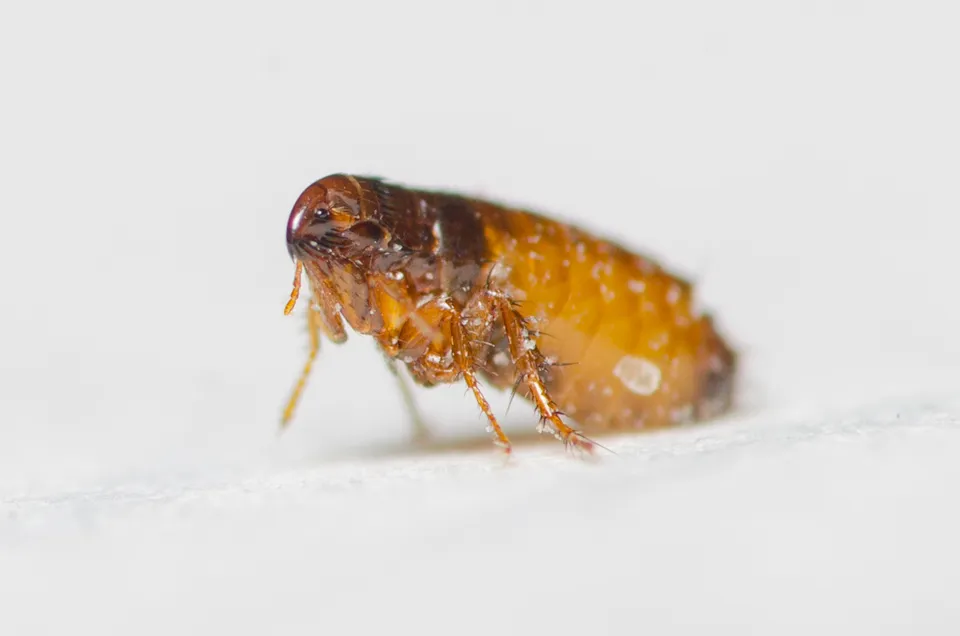
Quick Answer
An adult flea is a tiny, wingless insect no longer than about 1/8 inch (3 mm). It is reddish-brown to dark brown and flattened from side to side, so it seems to walk on its edge, and it has long hind legs built for jumping. Most fleas in U.S. homes are cat fleas, which live on cats and dogs. You usually spot them on pets, on white socks, or as black, pepper-like specks in pet fur.
On this page
Key Takeaways
- Adult fleas are up to about 1/8 inch (3 mm) long, reddish-brown, wingless and narrow from side to side.
- They jump instead of flying; cat fleas, the usual flea on U.S. cats and dogs, can jump about 6 inches straight up.
- Eggs, larvae and cocoons hide in carpets, bedding and furniture where pets rest, not on the pet.
- Flea dirt (dark, pepper-like specks in fur) and fleas landing on white socks are the easiest signs to check.
- Bed bugs are larger and flat from top to bottom; carpet beetles are round and usually sit near windows.
What does a flea look like up close?
A flea looks like a dark sliver standing on its side. Adults are reddish-brown, wingless insects no longer than about 1/8 inch, and their bodies are flattened from side to side, so they look "as if they are walking on edge" [1]. That narrow shape lets a flea slip between a pet's hairs. Penn State Extension describes cat fleas as dark brown, under 1/4 inch, with a last pair of legs "modified for jumping" and whisker-like spines on and near the head that experts use to identify them [3].
If the bug is tiny, dark, has no wings and vanishes with a jump, a flea is the most likely answer. Seen from the side, the body is an oval or teardrop with a small head at the front and three pairs of legs underneath, the back pair much longer than the others. Seen from above, a flea is so thin that it can be hard to make out at all, which is why fleas often look like a moving speck of dirt.
How big is a flea?
An adult flea is about the size of a pinhead: no more than about 1/8 inch, or roughly 3 mm [1]. That is big enough to see with the naked eye on a light surface, but small enough to disappear into dark carpet or fur. Its relatives in the house are smaller still: eggs are about 1/32 inch and larvae reach about 3/16 inch at most.
The chart below puts fleas next to the two bugs people most often confuse them with. A bed bug adult is noticeably bigger and wider, while a carpet beetle adult overlaps with fleas in length but is round instead of narrow.
| Stage | Size | What it looks like | Where you find it |
|---|---|---|---|
| Egg | About 1/32 inch | Pearly white, oval, smooth | Falls off the pet into bedding and carpet |
| Larva | Up to about 3/16 inch | Hairy, wormlike, brownish head, no eyes or legs | Deep in carpet fibers, under cushions, in pet beds |
| Pupa | Hidden in a cocoon | Small silk cocoon coated in lint and debris | Carpet, furniture, pet resting spots |
| Adult | Up to about 1/8 inch | Reddish-brown, wingless, narrow, jumps | On the pet, or jumping onto legs and socks |
Sizes and descriptions in the table come from UC IPM's flea guide [1].
What do flea eggs, larvae and cocoons look like?
Most of a flea problem is invisible, because the young stages live off the pet. Cat flea eggs are pearly white, oval and about 1/32 inch long, and they "readily fall from the pet" onto bedding and carpet [1]. Kentucky's extension entomologist notes that females lay 40 to 50 eggs a day in the fur, which then drop wherever the pet rests [2].
The larvae look like tiny, pale, hairy worms with a brownish head. They avoid light and feed on the dried blood and droppings that adult fleas leave behind. When grown, each larva spins a silk cocoon that picks up lint and fibers, which camouflages it. Because eggs, larvae and cocoons hide in carpets and furniture, seeing a few adult fleas usually means more are developing nearby.
The whole cycle can take only about 18 days at normal room temperature: eggs hatch in about 2 to 5 days, and larvae feed for 8 to 15 days before spinning cocoons [1]. Pupae usually stay in the cocoon for 1 to 4 weeks, and longer when conditions are poor [2]. That waiting stage is why fleas can seem to appear out of nowhere in a home that has been empty for a while.
What are the signs of fleas in your home?
You rarely need a magnifier to confirm fleas. These are the signs extension entomologists point to:
- Flea dirt in pet fur. Digested blood that fleas pass "appears as dark, pepper-like specs in the pet's fur" [2]. Part the fur near the base of the tail or on the belly and look for these black specks.
- The white sock test. Walk slowly through rooms where pets rest wearing white socks pulled up to the knee. Fleas that are present jump onto the socks and are easy to see against the white [1].
- Itchy bites low on the legs. Flea bites on people are usually most common on the ankles and lower legs [3]. A bite alone cannot prove which bug is responsible; our bed bug bite guide explains why finding the bug matters.
- A pet that scratches or chews its skin. Fleas spend most of their adult life on the animal, so pets usually show the problem first.
Check the places a pet sleeps and lies most, such as pet beds, rugs and sofa cushions in the living room and bedroom. Kentucky's guide also lists outdoor spots such as kennels, under decks and along the foundation [2]. If you have confirmed fleas, our step-by-step guide on how to get rid of fleas covers the house and yard.
Is it a flea, a bed bug or a carpet beetle?
The quickest test is shape: fleas are narrow side to side, bed bugs are flat and wide from top to bottom, and carpet beetles are round like tiny ladybugs. Behavior helps too. Fleas jump, bed bugs crawl and hide near beds, and carpet beetles fly and often turn up on windowsills.
| Feature | Flea | Bed bug | Carpet beetle (adult) |
|---|---|---|---|
| Length | Up to about 3 mm | Up to about 7 mm | About 2.5 to 5 mm |
| Shape | Narrow, flattened side to side | Flat, oval, broad from above | Round or oval, domed |
| Color | Reddish-brown to dark brown | Reddish-brown | Mottled white, brown and yellow, or shiny black |
| Wings | None | None | Yes, flies |
| How it moves | Jumps | Crawls | Crawls and flies |
| Where you see it | On pets, carpets, socks | Mattress seams, bed frames | Windowsills, drapes |
| Bites people? | Yes | Yes | No |
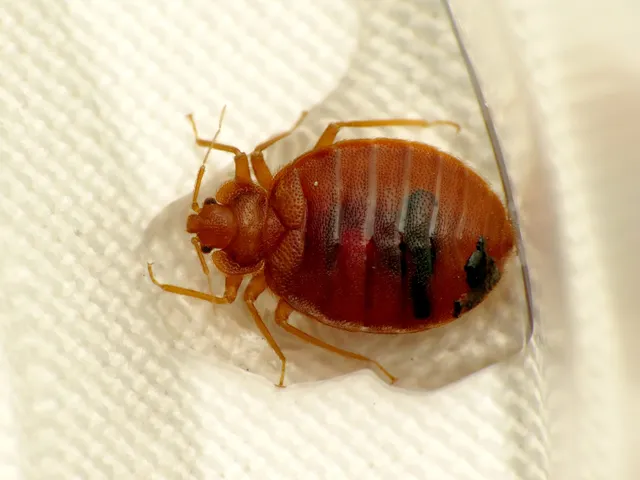
CDC describes bed bugs as small, flat, wingless, reddish-brown insects of 1 to 7 mm that hide in mattress seams, box springs and bed frames [4]. UC IPM describes the varied carpet beetle as about 1/10 inch long with a pattern of white, brown and dark yellow scales, and the black carpet beetle as 1/8 to 3/16 inch and shiny black; adults are usually seen on windowsills, drapes or window panes [5].
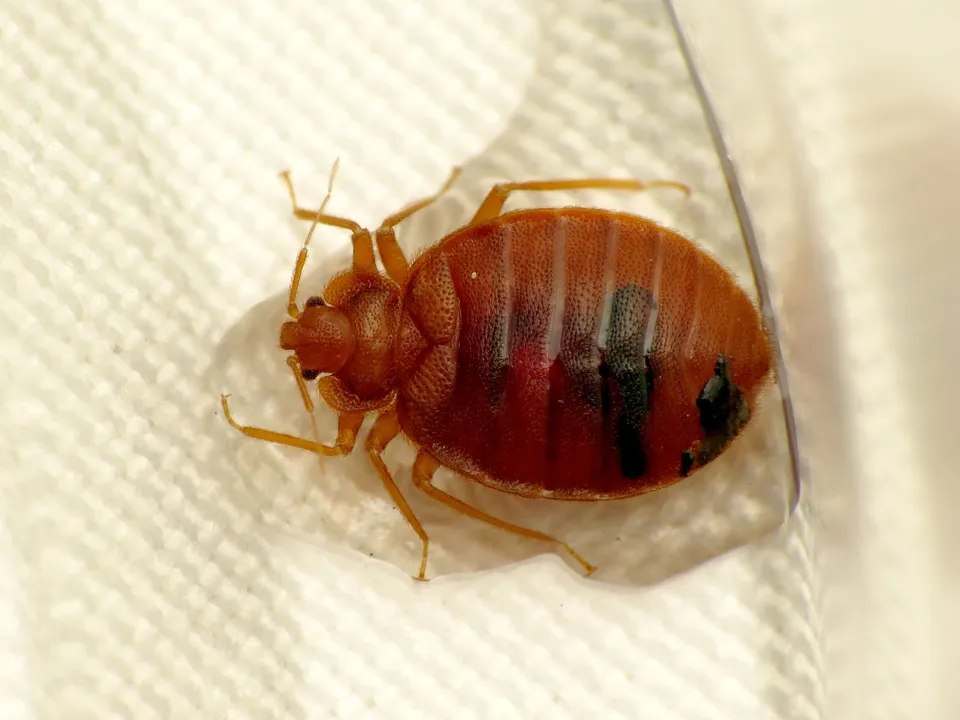
A bed bug is wider and flatter than a flea and never jumps. If the bug you found looks like this, read what a bed bug looks like next.
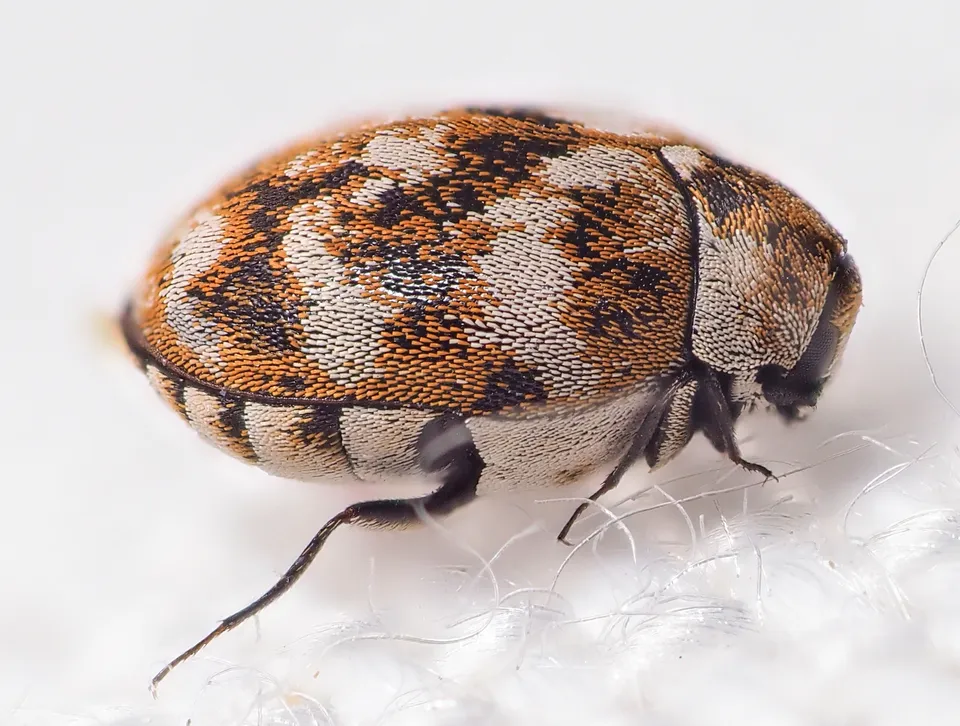
A carpet beetle adult is round and often patterned. It does not bite. For more lookalikes, try the BugWise bug identifier or browse the pest library.
When are fleas worst, and when should you get help?
Fleas can be found on pets all year, but UC IPM notes that numbers rise sharply in spring and early summer [1]. That pattern is typical across much of the U.S. and varies by region. Fleas live wherever pets do, and outdoor populations do best where it is mild and humid.
Fleas are more than a nuisance for some people. CDC says fleas can sometimes spread the germs that cause flea-borne typhus, plague or cat scratch disease, and that small children are at higher risk of flea-borne tapeworm if they accidentally swallow an infected flea [6]. For flea-borne typhus, CDC advises seeing your healthcare provider if you develop symptoms such as fever and chills, body aches, headache, nausea or rash, and mentioning any contact with fleas, rodents, stray animals or wildlife [7].
For the pet itself, ask your veterinarian. Flea treatment for cats and dogs depends on the animal's age, health and species, and a vet can check for related problems such as tapeworms. Treat the pet with a vet's advice and the home at the same time, because fleas you can see are only the adult part of the problem.
Frequently Asked Questions
Can fleas fly?
No. Fleas have no wings [1]. They jump instead, and adult cat fleas can jump vertically up to about 6 inches [2].
Can you see fleas with the naked eye?
Yes. Adults are up to about 1/8 inch long and show up well on white socks or light fabric. Eggs and larvae are much harder to spot because they are tiny, pale and hidden deep in carpet and furniture.
What does flea dirt look like?
Flea dirt looks like ground black pepper in your pet's fur. It is digested blood passed by adult fleas, and it also feeds the flea larvae that live in the pet's bedding.
Do cat fleas and dog fleas look different?
Not to the naked eye. UC IPM notes that dog fleas look like cat fleas, and the cat flea is the flea most often found on both cats and dogs [1].
Our Take
We think the white sock walk and a quick look for flea dirt answer the question faster than trying to inspect a jumping speck. Both checks come straight from extension guidance, cost nothing, and point you to where the problem lives: the pet and its resting spots. If what you found is wider than a flea, sits still near the bed, or turns up on a windowsill, compare it with bed bugs and carpet beetles before treating anything, because the fix is completely different. And once fleas are confirmed, we would call the veterinarian first. The adults on the pet are the source of every egg in the carpet, so the pet and the home need attention together.
Sources
- Pest Notes: Fleas. UC IPM, 2010.
- Flea Control and Prevention (ENTFACT-602). University of Kentucky Entomology, 2026.
- Cat Fleas. Penn State Extension, 2026.
- About Bed Bugs. CDC.
- Pest Notes: Carpet Beetles. UC IPM, 2020.
- About Fleas. CDC.
- About Flea-borne Typhus. CDC.
Pest activity and species vary by region. If you are unsure what you have, your local Cooperative Extension office can identify it. Always read and follow pesticide labels. Spotted an error? Tell us.
Keep Reading
What Does a Tick Look Like? Common US Ticks Compared
What ticks look like: flat, 8-legged, teardrop-shaped arachnids. Compare blacklegged, lone star and American dog ticks by size, color, markings and season.
What Does a Termite Look Like? Termites vs Flying Ants
See what termites look like: creamy white workers, big-jawed soldiers and dark winged swarmers, and how to tell termites from flying ants by waist and wings.
What Does a Brown Recluse Look Like?
How to recognize a brown recluse: a plain tan to brown spider with even-colored legs and 6 eyes in 3 pairs, why the violin mark misleads, and wolf spider tips.
What Does a Bed Bug Look Like? Every Life Stage
What bed bugs look like at every stage: apple-seed adults, pale nymphs and pinhead eggs, with a size scale, lookalikes like carpet beetles and signs to check.