How to Get Rid of Fruit Flies (Fast and for Good)
Quick Answer
To get rid of fruit flies, remove what they breed in: overripe produce, spilled juice, sticky recycling, damp mops and the film inside drains. Refrigerate ripe fruit, take out the trash, then catch the adults left over with a jar of apple cider vinegar and a drop of dish soap. Sprays alone fail while breeding spots remain, because one week is enough for a new generation.
On this page
- How do you know they are fruit flies?
- Where are the fruit flies coming from?
- How do you get rid of fruit flies step by step?
- How do you make a fruit fly trap that works?
- Should you use a spray or a bug bomb for fruit flies?
- How do you keep fruit flies from coming back?
- Frequently Asked Questions
- Our Take
- Sources
Key Takeaways
- Fruit flies breed in moist, fermenting food and gunk, so finding every breeding spot is the real fix.
- Egg to adult takes about a week, which is why a single forgotten onion can restart the problem.
- A cider vinegar trap with a drop of dish soap catches adults, but it does not stop breeding.
- Sprays and bug bombs are rarely needed; if you use one, read and follow the label.
How do you know they are fruit flies?
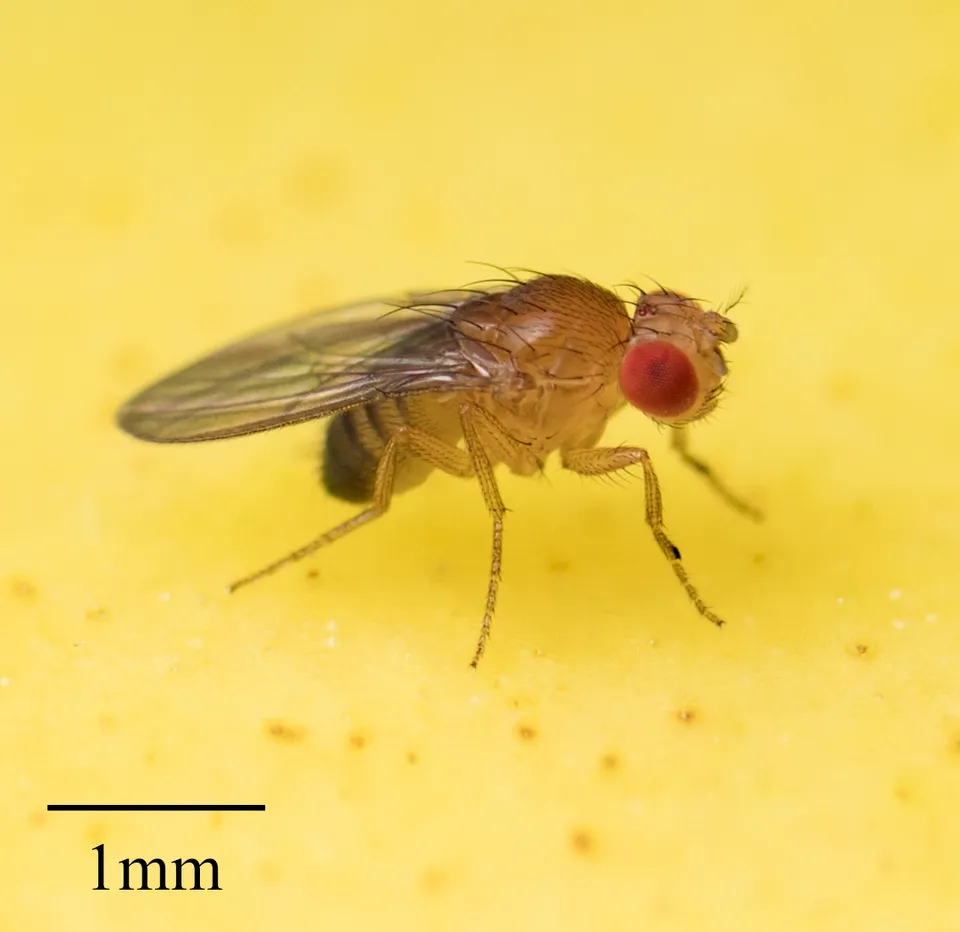
Fruit flies are tiny: about 1/8 inch (2 to 3 mm) long, with a tan front half, a darker or black rear and red eyes [1]. Minnesota Extension gives the same picture, 1/16 to 1/8 inch with tan bodies, darker abdomens and red eyes that can fade after the fly dies [2]. They hover slowly around fruit bowls, wine glasses, the trash can and the sink.
Two other small flies often get mistaken for them. Use this quick check before you start, because each one needs a different fix:
| What you see | Most likely | Where it breeds | Guide |
|---|---|---|---|
| Tan body, red eyes, hovering over fruit or trash | Fruit fly | Fermenting food, juice, drains | This page |
| Slender black fly with long legs, near houseplants | Fungus gnat | Damp potting soil | Gnat guide |
| Fuzzy gray fly with moth-like wings, resting on bathroom walls | Drain fly | Slime film inside drains | Drain fly guide |
If you are still not sure, our bug identifier walks you through it, and the fruit fly profile lists size, colors and the months they are most active.
Where are the fruit flies coming from?
Fruit flies do not appear from nowhere: every one of them grew up in a moist, fermenting spot somewhere in your home. A female can lay about 500 eggs near the surface of fermenting or moist organic material, and the larvae feed right there [1]. Kentucky's list of common breeding spots is longer than most people expect:
- Overripe tomatoes, melons, squash, grapes and bananas on the counter
- A forgotten potato or onion at the back of a pantry bin
- Fruit juice spilled under the refrigerator
- Drains and garbage disposals
- Empty bottles and cans, and a recycling bin that never gets rinsed
- Trash containers, mops and cleaning rags
- Poorly sealed home canning, wine, cider or beer containers
Maryland Extension adds that damp mops and towels can hold enough food and moisture for larvae to develop [3]. The map below shows where to look in a typical kitchen.
A quick way to test a drain: tape a clear plastic food storage bag over the opening overnight. If adults are developing inside, they fly up into the bag [1].
How do you get rid of fruit flies step by step?
Sanitation is the main control, and Maryland Extension puts it first for that reason [3]. Work through these steps in one go:
- Deal with the produce. Eat, refrigerate or throw out ripe fruit and vegetables. Cut away damaged parts and discard them. Check potato and onion bins for anything soft.
- Take out the trash and recycling. Rinse and drain bottles and cans before they go in the bin, and wash the bin itself if it has a sticky film.
- Clean up spills. Pull out the refrigerator kick plate if you can and wipe up old juice or soda. Wipe the area under fruit bowls and wine racks.
- Dry out mops and rags. Wring mops thoroughly and let them dry; replace sour-smelling sponges and towels.
- Clean the drains. Scrub sink and disposal drains with a brush to remove the film where larvae feed, then repeat the bag test.
- Trap the adults. Set out vinegar traps (next section) to catch flies that already hatched.
The life cycle explains why speed matters. Maryland Extension says larvae feed for 5 to 6 days and the whole cycle takes 8 to 10 days [3], and Nebraska Extension notes it can be as short as a week [4]. If you clear the breeding spots today, flies that keep showing up after two weeks point to a source you have not found yet.
How do you make a fruit fly trap that works?
A homemade vinegar trap is the simplest way to catch the adults. Nebraska Extension describes it this way [4]:
- Pour about an inch of apple cider vinegar into a small glass, jar or yogurt cup.
- Add one drop of dish soap and swirl. The soap breaks the surface tension, so flies that land sink instead of standing on top.
- Cover the top with plastic wrap and poke a few toothpick holes, or set a rolled paper funnel in the opening.
- Put traps where you see the most flies, and refresh them every few days.
Kentucky suggests the same jar and paper funnel idea and notes a slice of banana also works as the lure [1].
| Trap setup | What it does well | Limits |
|---|---|---|
| Cider vinegar + drop of dish soap, open | Easy, catches flies that land | Flies may land and leave if there is no soap |
| Cider vinegar + plastic wrap with small holes | Flies get in, few get out | Holes must be small; refresh the vinegar |
| Paper funnel over a jar with banana slice | Strong lure, no liquid to spill | Needs emptying before the banana starts breeding flies |
A trap catches the adults you can see, but it does nothing about the eggs and larvae already in your kitchen. Nebraska Extension says that once food sources are gone, it can take a couple of weeks for the remaining flies to die off, and traps just speed that up [4].
Should you use a spray or a bug bomb for fruit flies?
Usually not. Kentucky is blunt about it: insecticides aimed at adults will not solve a fruit fly problem while the breeding sites remain, no matter how often you spray [1]. Nebraska Extension says no insecticide is needed at all once food sources and breeding sites are gone [4].
If adults are still flying after the cleanup, Kentucky says an aerosol with pyrethrins (a botanical insecticide) can knock down the leftovers. Pick an EPA-registered product labeled for flying insects indoors. Read and follow the label. The label is the law. Keep children and pets out of the room as the label directs, cover or remove food and dishes, and store the can out of their reach [5].
Skip total release foggers (bug bombs). The National Pesticide Information Center explains that fogger mist does not reach into cracks and voids where pests hide, that the contents can catch fire and pose explosion hazards, and that using more foggers than the label says only increases risk [6]. Never mix your own concoctions from household chemicals either.
How do you keep fruit flies from coming back?
Fruit flies can show up in any month, but Kentucky notes they are especially common in late summer and fall, when ripe produce and canning season bring them in [1]. Minnesota Extension also sees indoor problems in fall and winter [2].
Prevention is the same habits as the cleanup, kept up:
- Keep ripe fruit in the refrigerator, especially bananas, tomatoes and melons in late summer.
- Rinse bottles and cans before recycling, and empty kitchen trash often.
- Let mops, rags and sponges dry between uses.
- Scrub kitchen drains every week or two so film does not build up.
- Use tight-fitting screens on windows and doors; Kentucky recommends 16-mesh [1].
- Seal home canning, wine and cider containers well.
When should you call a licensed pest professional? If flies keep appearing after two or three weeks of thorough cleaning, the source may be somewhere hard to reach, such as a broken pipe, a floor drain or a spill under built-in cabinets. A professional can inspect for it. You can browse other kitchen and pantry pest guides while you narrow it down.
Frequently Asked Questions
Do fruit flies bite?
No. Neither Kentucky nor Minnesota Extension describes fruit flies as biters, and Minnesota says they are generally not considered a health problem [2]. They can carry bacteria onto food, so throw out anything they have been crawling on.
Why do I have fruit flies when there is no fruit out?
Fruit is only one breeding spot. Drains, garbage disposals, sticky recycling, spilled juice under the refrigerator, damp mops and a single rotting potato or onion can all produce flies [1]. Use the bag test on each drain and check storage bins.
How long does it take to get rid of fruit flies?
Plan on about two weeks. Once breeding spots are gone, Nebraska Extension says the remaining adults can take a couple of weeks to die off, and traps speed that up [4].
Are the small flies in my bathroom fruit flies?
Possibly, but fuzzy gray flies resting on bathroom walls are more likely drain flies, and black flies around plant pots are usually fungus gnats. See our guides to drain flies and fungus gnats.
Our Take
We think most fruit fly advice puts the trap first, and that is backwards. The extension sources we used agree that a fruit fly problem is really a breeding site problem: one overripe banana, a sticky recycling bin or a filmy drain can keep producing new adults about every week, and no trap or spray can keep up with that. Our suggestion is to spend the first hour hunting and cleaning, with the bag test on every drain, and only then set out cider vinegar traps to mop up the stragglers. If flies still show up after two weeks, assume you missed a spot rather than reaching for a stronger product. A spray is a last step, not a first one, and bug bombs are not worth the risk for an insect this small.
Sources
- Fruit Flies (ENTFACT-621). University of Kentucky Entomology, 2026.
- Fruit flies: What insect is this?. University of Minnesota Extension, 2026.
- Fruit Flies. University of Maryland Extension, 2024.
- Fall is the Time for Fruit Flies. Nebraska Extension in Lancaster County, 2024.
- Pesticide Safety: The Label is the Law. UF/IFAS Gardening Solutions, 2026.
- Total Release Foggers. National Pesticide Information Center, 2025.
Pest activity and species vary by region. If you are unsure what you have, your local Cooperative Extension office can identify it. Always read and follow pesticide labels. Spotted an error? Tell us.
Keep Reading
How to Get Rid of Mosquitoes in Your Yard
Get rid of yard mosquitoes at the source: dump standing water weekly, clean gutters, cover rain barrels, treat ponds, keep screens tight and call local control.
How to Get Rid of Stink Bugs Indoors
Get rid of stink bugs indoors without the smell: vacuum or drop them in soapy water, never crush them, and seal cracks before fall, when they move inside.
How to Get Rid of Silverfish
Get rid of silverfish by drying out damp rooms, fixing leaks, clearing old paper and boxes, and catching them in simple jar traps. See when dusts or a pro help.
How to Get Rid of Drain Flies
Get rid of drain flies by finding the breeding drain with a cup test, then scrubbing out the slimy film. Boiling water and bleach fail; here is what works.
How to Get Rid of Fleas in the House
Get rid of fleas in the house: have your vet treat every pet, vacuum daily, wash pet bedding, treat flea hot spots and keep at it for weeks while cocoons hatch.

How to Get Rid of Termites: DIY vs Professional
Termites in your house need a licensed pro, but you can spot the signs, fix moisture and wood-to-soil contact, and choose a company wisely. Here is what helps.