How to Get Rid of Mice in the House

Quick Answer
To get rid of mice in the house, seal every gap a mouse can squeeze through (about 1/4 inch), set plenty of snap traps along walls where you find droppings, and take away food, water and nesting spots. Check the traps daily and keep going until all signs stop. Clean up droppings with CDC's wet-cleaning method, never by sweeping or vacuuming, and call a licensed pest professional if mice keep coming back.
On this page
Key Takeaways
- Mice fit through openings about 1/4 inch wide, so sealing gaps with steel wool, metal or cement is what keeps new mice out.
- CDC recommends snap traps and advises against glue traps and live traps, which can make mice urinate and raise your risk of getting sick.
- Put traps no more than about 10 feet apart along walls, check them daily and keep trapping for at least 15 days.
- Ultrasonic repellers have little evidence behind them; sealing and trapping do the real work.
- Never sweep or vacuum droppings. Follow CDC's cleanup page: air the room out, wear gloves and wet everything with disinfectant first.
How do you know you have mice?
The usual first clue is droppings: small, dark, rice-sized pellets along walls, in drawers or under the sink. University of California IPM lists the other signs as fresh gnaw marks, tracks, nests of finely shredded paper or fabric tucked behind boxes or in garages, and a musky smell when an infestation is large or long-lasting [1]. Mice are mostly active at night, so you may hear scratching in walls or cabinets before you ever see one.
An adult house mouse is light brownish to gray, with fairly large ears, small black eyes and a nearly hairless tail. It measures about 5 to 7 inches including a 3 to 4 inch tail. If the mouse has a white belly, bigger eyes and a furry tail, it may be a deer mouse, which UC IPM describes as the common lookalike [1]. Our house mouse profile has more identification details.
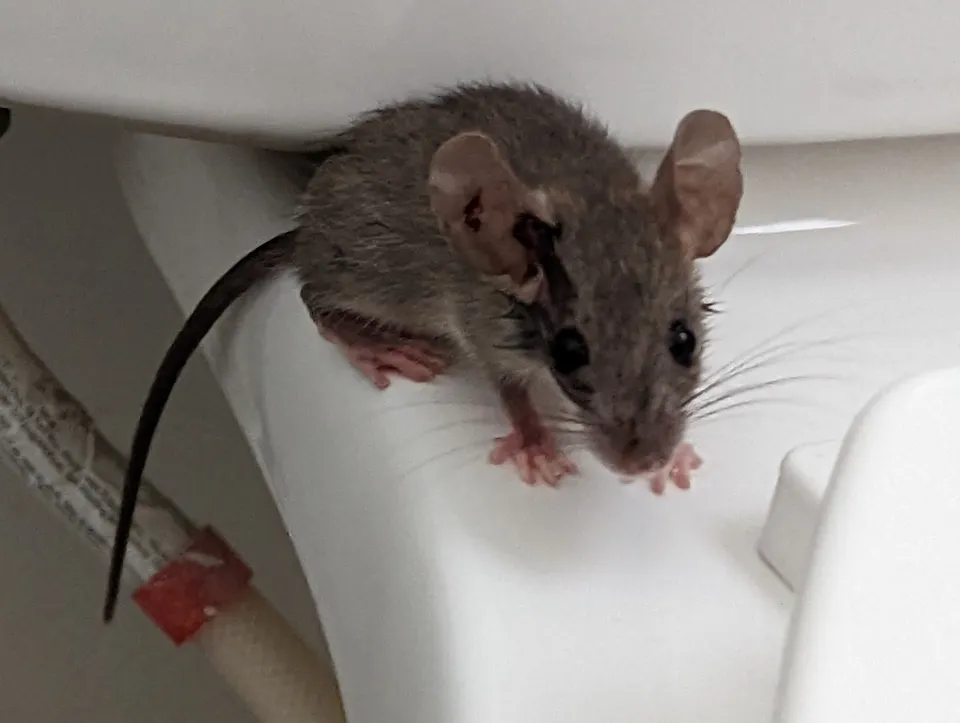
Timing matters too. Outdoor mice often move indoors in autumn, when nighttime temperatures drop, which is why many people first notice them from about September through November (typical across much of the U.S.; varies by region). Once inside, they stay active all year.
How do you keep mice out of the house?
Sealing entry points is the step that stops new mice from replacing the ones you trap. CDC says mice can fit through an opening about 1/4 inch (6 mm) wide and tells homeowners to fill small holes with steel wool held in place with caulk or spray foam, and to cover larger holes with lath screen, metal, cement, hardware cloth or metal sheeting [2]. Foam, rubber, vinyl, plastic screening and wood alone will not stop a mouse, because mice chew through them. UC IPM adds that metal edging on doors may be needed to stop gnawing and that steel wool pads can rust, so treat them as a temporary plug [1].
Where to look, inside and out:
- Indoors: around kitchen cabinets, pipes under sinks, behind appliances, around vents, and in the basement or crawl space.
- Outdoors: roof rafters, eaves and soffits, around windows and doors, between the foundation and the ground, and where utility lines enter.
Then make the house less inviting. CDC recommends storing food in thick plastic, metal or glass containers with tight lids, not leaving pet food or water out overnight, keeping trash in lidded cans, keeping woodpiles and compost bins away from the house, and trimming brush and weeds near the home. Mice are good climbers, so UC IPM also suggests cutting back plants that touch the walls. The kitchen is where most of this happens, and the same habits help with cockroaches.
What is the best way to trap mice?
For most homes, snap traps are the best tool: they are cheap, fast, and let you confirm each catch. CDC recommends traditional snap traps for reducing rodent numbers and advises against glue traps and live traps, because they can scare rodents into urinating, which can raise your chance of getting sick [3].
How to set them so they actually work:
- Bait lightly. CDC suggests a small amount of chunky peanut butter on the bait pan. UC IPM notes that too much bait lets a mouse lick it off without springing the trap, and that cotton balls or dental floss can lure females looking for nest material.
- Make a "T" with the wall. Place the trap against the wall with the baited end touching it, so a mouse running along the wall crosses the trigger.
- Use more traps than you think. UC IPM advises spacing traps no more than about 10 feet apart, and says a pair set 1 to 2 inches apart can improve catches.
- Pick the right spots. Behind the stove and refrigerator, under sinks, in dark corners, and wherever you find droppings.
- Check daily and keep going. CDC says to check traps every day, refresh or move bait weekly, and keep trapping for at least 15 days, continuing until there is no more activity.
Wear disposable gloves when you empty traps and wash your hands afterward. Keep traps where children and pets cannot reach them.
| Option | What sources say | Best use |
|---|---|---|
| Snap traps | CDC's recommended trap; fast and easy to check | First choice indoors |
| Glue boards | CDC advises against them; UC IPM says adult mice often avoid them and caught mice may not die quickly | Not recommended |
| Live (catch) traps | CDC advises against them; UC IPM says released mice can find their way back from about half a mile | Not recommended |
| Bait stations (poison) | Only if trapping fails; slow acting, mice may die in walls | Persistent problems, label rules apply |
| Ultrasonic devices | UC IPM: little evidence they drive out mice | Skip |
If you are not sure the animal is a mouse at all, our pest guide covers other common household pests.
Should you use mouse poison?
Treat poison as a backup, not a starting point. CDC says to use poison or bait stations only if the infestation persists after trapping, and only EPA-registered products [3]. EPA rules say rodenticides sold to consumers must come as ready-to-use bait stations; loose pellets are no longer allowed in consumer products, and stations must resist tampering by young children and dogs [6].
Read and follow the label. The label is the law. Place bait stations only where children, pets and wildlife cannot reach them, and never take bait out of the station.
Know the trade-offs before you buy. UC IPM explains that rodenticide baits generally take several days to work, that mice usually stay within about 30 feet of their nests and may die inside walls and cause odors, and that some active ingredients can pass up the food chain to predators that eat poisoned mice. That is why trapping is often the better choice inside a lived-in home. If a child or pet may have eaten bait, call Poison Control or your veterinarian right away and have the product label with you.
How do you clean up mouse droppings safely?
Cleanup is where people most often put themselves at risk, so follow CDC's page on how to clean up after rodents [4] step by step rather than improvising [4]. In short, CDC says to air the space out before you start, wear rubber or plastic gloves, and wet droppings, urine and nesting material with a disinfectant before wiping them up. Never sweep or vacuum mouse droppings, urine or nests, because that stirs up dust that can carry germs. The CDC page also covers dead mice, nests, fabrics, carpets, vehicles and air ducts, and it recommends calling a professional for ducts.
Why the care? CDC states that rodents can carry many diseases that spread to people, and that an infestation in and around the home is the main reason those diseases spread [5]. UC IPM names salmonella, leptospirosis and lymphocytic choriomeningitis (LCM) among the germs house mice can carry, and notes that mouse urine is a major allergen linked to asthma in sensitive children. CDC's cleanup page even suggests insect repellent when you handle dead rodents or nests, because rodents can carry fleas; if you notice bites after a mouse problem, see our guide to getting rid of fleas.
If anyone in the home feels sick after contact with rodents or their droppings, contact a doctor and mention the rodent exposure.
When should you call a pest professional?
Call a licensed pest professional when trapping has not stopped the activity after a few weeks, when you cannot safely reach the entry points (roof lines, attics, crawl spaces), or when droppings are widespread. CDC suggests professional help if trapping does not solve the problem, and it says a pest control specialist can help with areas you cannot safely reach; your local or state health department is another contact if you suspect a large infestation [2]. Ask any company you hire to start with an inspection and a sealing plan, not just bait. For other pests in the house, browse all our get-rid-of guides.
Frequently Asked Questions
How long does it take to get rid of mice?
Plan on at least two weeks. CDC says to keep trapping for at least 15 days and to continue until you see no more rodent activity [3]. The work goes faster when gaps are sealed first, because new mice cannot replace the ones you catch.
Do ultrasonic mouse repellers work?
Not well. UC IPM says ultrasonic sound is directional, does not travel behind furniture, fades quickly with distance, and that mice get used to repeated sounds. It finds little evidence that these devices drive out established mice or prevent new ones [1].
Can I catch mice alive and release them outside?
CDC advises against live traps because frightened mice may urinate and raise your risk of illness. UC IPM adds that relocation does not work well, since mice have navigated back from as far as half a mile, and that releasing them can be illegal in some places, such as California without a permit.
Our Take
We think most mouse problems are lost at the sealing step, not the trapping step. People set a few traps, catch a couple of mice, and stop, while the 1/4 inch gap under the sink keeps letting new ones in. Based on CDC and UC IPM guidance, our order is simple: find and seal entry points with metal-based materials, set more snap traps than feel necessary, and keep going for the full 15 days CDC recommends. We would skip glue boards and ultrasonic plug-ins entirely. Bait stations have a place, but in a lived-in home a mouse dying inside a wall is a real downside. And when cleanup time comes, we would follow CDC's page exactly rather than reaching for a broom. See our editorial policy for how we choose sources.
Sources
- Pest Notes: House Mouse. University of California Statewide IPM Program.
- How to Seal Up to Prevent Rodents. Centers for Disease Control and Prevention.
- How to Trap Rodents. Centers for Disease Control and Prevention, 2024.
- How to Clean Up After Rodents. Centers for Disease Control and Prevention.
- Controlling Wild Rodent Infestations. Centers for Disease Control and Prevention.
- Restrictions on Rodenticide Products. U.S. Environmental Protection Agency.
Pest activity and species vary by region. If you are unsure what you have, your local Cooperative Extension office can identify it. Always read and follow pesticide labels. Spotted an error? Tell us.
Keep Reading

How to Get Rid of Mosquitoes in Your Yard
Get rid of yard mosquitoes at the source: dump standing water weekly, clean gutters, cover rain barrels, treat ponds, keep screens tight and call local control.
How to Get Rid of Stink Bugs Indoors
Get rid of stink bugs indoors without the smell: vacuum or drop them in soapy water, never crush them, and seal cracks before fall, when they move inside.

How to Get Rid of Silverfish
Get rid of silverfish by drying out damp rooms, fixing leaks, clearing old paper and boxes, and catching them in simple jar traps. See when dusts or a pro help.
How to Get Rid of Drain Flies
Get rid of drain flies by finding the breeding drain with a cup test, then scrubbing out the slimy film. Boiling water and bleach fail; here is what works.
How to Get Rid of Fleas in the House
Get rid of fleas in the house: have your vet treat every pet, vacuum daily, wash pet bedding, treat flea hot spots and keep at it for weeks while cocoons hatch.

How to Get Rid of Termites: DIY vs Professional
Termites in your house need a licensed pro, but you can spot the signs, fix moisture and wood-to-soil contact, and choose a company wisely. Here is what helps.